
Ask three maintenance managers how often they service their robots and you will get three different answers, usually because one runs Fanuc, one runs ABB and one runs KUKA. Each manufacturer writes its own maintenance schedule, uses its own controller family and packages support in its own way.
This guide compares robot maintenance by brand: what Fanuc, ABB and KUKA each recommend, where the real differences sit, and what stays exactly the same whatever the colour of the arm. It extends our complete industrial robot maintenance guide with the brand-level detail.
Table of Contents
In summary
Fanuc robot maintenance is typically expressed in operating hours (greasing every 3 years or 11,520 hours is the classic figure in Fanuc documentation), ABB schedules gearbox oil and SMB battery care through model-specific manuals, and KUKA sells maintenance as defined packages. Underneath, the fundamentals are identical, and the environment, not the brand, decides the real interval. Since 1998, we have protected more than 5,000 robots across all three brands (and 50+ others) at RCC.
Why robot maintenance differs by brand
Every industrial robot needs the same care: lubrication, battery replacement, cable inspection, controller checks and periodic mastering. What changes by brand is the packaging of that care: the intervals printed in the manual, the controller architecture, the spare parts logistics and the way preventive maintenance services are sold.
That packaging matters for planning and budgeting. A maintenance plan that treats a mixed fleet as one homogeneous block will over-service some units and, more dangerously, under-service others. If you run several brands side by side, our robot maintenance checklist shows how to structure the routine tasks that apply to all of them.
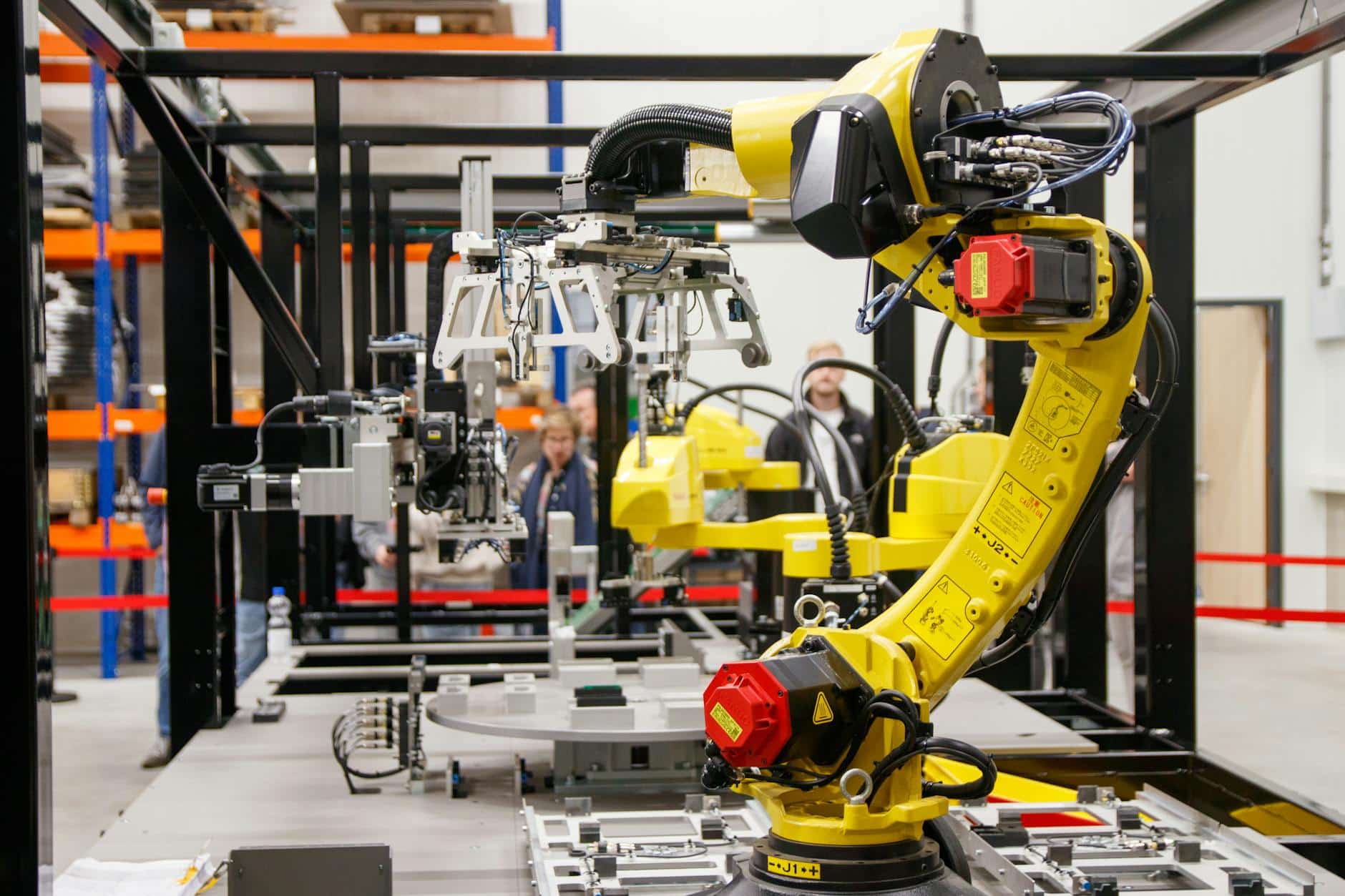
Fanuc robot maintenance: hours, grease and batteries
Fanuc expresses its preventive maintenance schedule in operating hours. The figure most maintenance teams know by heart: grease replacement every 3 years or 11,520 operating hours, whichever comes first, for most six-axis models. Backup batteries in the controller and the mechanical unit protect mastering data, and yearly replacement is common practice; a dead battery means re-mastering the robot before production restarts.
Fanuc America’s service documentation and regional support networks make routine maintenance straightforward to plan: inspection points, greasing procedure and battery replacement are described step by step in the manual for each mechanical unit and R-30iB controller generation. The discipline is in the execution, not the paperwork. One detail teams underestimate: cable wear. Dress-pack cables flex on every cycle, and in high-cycle applications they fail long before the gearboxes do.
ABB robot maintenance: oil, SMB batteries and OmniCore
ABB structures maintenance through model-specific product manuals. Many ABB models use oil-lubricated gearboxes, with oil changes scheduled on multi-year intervals that depend on the model and duty cycle, and every ABB robot carries an SMB battery that preserves revolution counter data when power is cut.
On the controller side, IRC5 and the newer OmniCore generation carry their own inspection points (filters, fans, backups). ABB’s connected services can push condition data to the maintenance team, useful for moving from calendar-based to condition-based preventive maintenance on high-value cells.
KUKA robot maintenance: packages and low-maintenance controllers
KUKA packages maintenance differently: rather than a single hour figure, it defines maintenance packages covering the base axes, the in-line wrist and the electrical installation, each with its own scope and cadence. Gear oil changes for the axes are part of those packages, and KUKA promotes its KR C4 and KR C5 controllers as largely maintenance-free by design.
For planning purposes, that package logic is convenient: you buy a defined scope of work instead of assembling tasks yourself. The trade-off is the same as any OEM offer, so it is worth comparing the in-house, OEM and outsourced routes; we walk through that decision in our guide to industrial robot servicing models.
Fanuc vs ABB vs KUKA: maintenance at a glance
Always confirm against the manual for your specific model and duty cycle; the table summarises typical published guidance, not a substitute for it.
| Fanuc | ABB | KUKA | |
|---|---|---|---|
| How the schedule is expressed | Operating hours (greasing typically every 3 years or 11,520 h) | Model-specific manuals, multi-year gearbox oil intervals | Defined maintenance packages (base axes, in-line wrist, electrical) |
| Controller family | R-30iB and successors | IRC5, OmniCore | KR C4, KR C5 |
| Battery care | Backup batteries, yearly replacement is common practice | SMB battery preserving revolution counter data | Controller and RDC batteries per maintenance package |
| What the manual cannot fix | Dust, weld spatter, paint mist, heat and washdown chemicals: the environment shortens every interval above, whatever the logo on the arm | ||
Running Fanuc, ABB or KUKA robots in dust, heat or spatter?
See how custom covers compare to standard protection →What never changes: the environment around the robot
Brand guidance assumes a clean cell. Most factories do not have one. Dust, weld spatter, paint mist, heat and washdown chemicals shorten every interval in every manual: general guidance sits around inspections every 2,000 to 5,000 operating hours, and harsh environments push you to the aggressive end of that range, whatever the brand.
That is where physical protection earns its keep. Facilities using tailored covers report 25 to 40 percent longer intervals between service events, because the cover removes contamination at the source instead of letting the maintenance plan absorb it. At a French automotive manufacturer, the custom covers we installed on Fanuc welding robots contributed to zero contamination-related production stoppages on the line.

A cover is made to measure from the robot’s geometry, so a Fanuc arm, an ABB IRB or a KUKA KR each gets its own pattern, cut and sewn in our workshop in Toul, France. The principle, and the return on investment, is brand-agnostic: less contamination, fewer unplanned repairs, a longer life for the same automation investment. The cost side of that equation is detailed in our robot maintenance cost analysis.
One thing we are not: a repair shop. RCC is an independent French manufacturer of protective covers; we do not provide OEM repair or servicing for Fanuc, ABB or KUKA, and warranty work should always go through the manufacturer’s service network. What we do is make sure your robots need that network as rarely as possible. Key terms used in this article are defined in our technical glossary.
Frequently asked questions
Fanuc’s maintenance documentation typically calls for greasing every 3 years or 11,520 operating hours, whichever comes first, with backup batteries replaced on a yearly cycle. In dusty or hot environments, inspections should run more often; always confirm against the manual for your specific model.
The fundamentals are identical: lubrication, battery care, cable inspection and controller checks. The difference is packaging. KUKA structures maintenance in defined packages covering base axes, in-line wrist and electrical checks, while Fanuc expresses its schedule in operating hours.
Many ABB models use oil-lubricated gearboxes, and ABB’s product manuals schedule oil changes on multi-year intervals that depend on the model and duty cycle. ABB robots also carry an SMB battery that preserves revolution counter data and needs periodic replacement.
No. Dust, weld spatter, paint mist and heat attack a Fanuc, ABB or KUKA robot in exactly the same way. A protective cover is made to measure for the robot’s geometry, so the brand changes the pattern, not the principle. Facilities using tailored covers report 25 to 40 percent longer intervals between service events.
Want fewer maintenance events, whatever the brand on the arm?
We audit your robot cell for free and design a made-to-measure cover for your Fanuc, ABB or KUKA units, manufactured in France.
Request a free audit →Reviewed by René Domingues, founder of Robotic Cover Concept – a French manufacturer of custom robot protection covers since 1998, based in Toul, France, with units protected across Europe, Israel and Brazil.