
In summary: robot protective covers exist to keep heat, spatter, dust, chemicals and moisture out of the joints, seals and cabling of an industrial robot, without ever restricting the motion the program needs. Three decisions settle whether a cover works: the material, which follows the dominant stress of the cell rather than a general idea of toughness; the construction, which decides how long it lasts and how quickly it comes off for service; and the fit, which comes from measuring the machine as installed. RCC has designed and manufactured custom robot protection since 1998, from Toul in France, for Fanuc, ABB, KUKA, Yaskawa and Stäubli machines running in Europe, Israel and Brazil.
Table of Contents
What a Robot Protective Cover Is Actually For
An industrial robot is a sealed mechanical assembly with a small number of vulnerable points: the wrist seals, the joint bearings, the connectors, the cabling that runs along the outside of the arm, and the paintwork that protects everything else. A protective cover is a barrier placed between those points and whatever the process throws at them.
The installed base keeps growing: 542,000 industrial robots were installed worldwide in 2024, the fourth consecutive year above 500,000, and the operational stock reached 4,664,000 units, according to the IFR World Robotics 2025 report. Each of those machines sits in a specific cell, with its own tooling and its own hazards, which is why protection is specified per installation rather than per robot model.
That barrier has to satisfy two requirements at once, and they pull in opposite directions. It has to be dense enough to stop the contaminant, and flexible enough to follow the arm through its full working envelope without loading a joint or snagging on the cell. A cover that only meets the first requirement fails within weeks, because the arm destroys it. A cover that only meets the second lets the process through.
This is also why protection is rarely a single item. A working assembly usually combines a main cover over the arm, dedicated components at the joints that articulate most, and separate protection for the cable and hose bundle. Which component belongs where, and how industrial robot jackets and bellows differ from one another, is a subject in its own right, and we cover it piece by piece in the guide dedicated to it. Which of those components a given machine needs also depends on its kinematics, set out in our guide to robot covers by robot type.
The Materials, and What Each One Handles
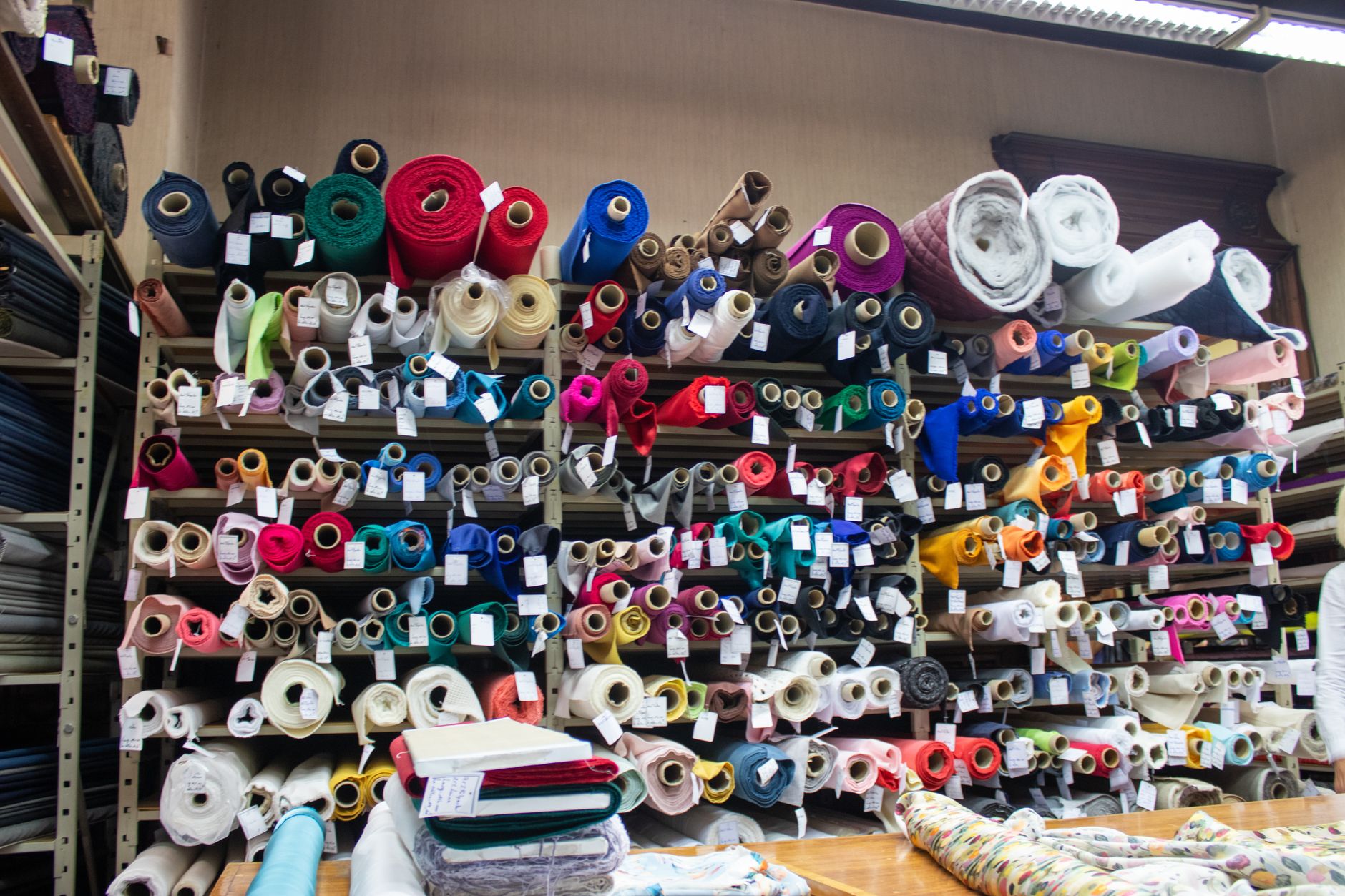
There is no universal fabric. Every material trades one property against another, and the right choice is the one whose weakness your cell does not exercise.
| Material family | What it is good at | Where it gives way | Typical use |
|---|---|---|---|
| Silicone-coated glass fabric | Radiant heat, spatter, sustained high temperature | Heavier, less supple than polymer coatings | Welding, foundry, forge |
| Aramid-based fabric | Tear strength, cut resistance, flame retardancy | Cost, and limited chemical resistance on its own | Handling near sharp parts, high-abrasion cells |
| Polyurethane-coated textile | Suppleness, abrasion, oil and coolant | Temperature ceiling well below welding | Machining, assembly, palletising |
| PVC-coated textile | Water, detergents, low cost, easy cleaning | Solvents and heat | Food, washdown, packaging |
| PTFE-coated fabric | Chemical inertness, non-stick surface | Mechanical fatigue on tight folds | Chemical processing, coating lines |
| Aluminised composite | Reflects radiant heat | Surface layer is vulnerable to abrasion | Proximity to molten metal, furnace doors |
Two properties are read wrongly more often than the rest. A temperature rating is a sustained rating, not a spatter rating: a fabric rated for continuous exposure at a given temperature will still let through a droplet of molten metal arriving at a much higher one. And chemical resistance is specific to the chemical. The solvent that cleans a cover can dissolve a coating that shrugs off cutting fluid, which is why the cleaning regime belongs in the specification alongside the process itself.
Where a cell combines stresses, heat and abrasive dust for instance, or solvent and spray, a single-layer fabric is usually the wrong answer. Multi-layer construction lets each layer do one job: a reflective or heat-resistant outer face, a mechanical core carrying the tear strength, and an inner face chosen for the contact against the robot itself.
Matching the Cover to the Environment
The dominant stress of the cell, not the industry it belongs to, is what selects the material. Two robots in the same plant can need entirely different covers.
| Environment | Dominant stress | What the cover must do | Construction detail that matters |
|---|---|---|---|
| Welding | Spatter, radiant heat, UV | Stop molten droplets without hardening | Sectioned wrist, replaceable high-exposure panels |
| Foundry and forge | Radiant heat, splash, abrasive dust | Reflect heat and shed particles | Aluminised outer face, sealed openings |
| Paint and coating | Overspray, solvents | Survive frequent cleaning without degrading | Smooth outer face, quick-release for frequent changes |
| Machining | Swarf, coolant, oil mist | Resist oil and repeated impact from chips | Reinforcement at contact points, drainage |
| Food and washdown | Hot water, detergents, hygiene rules | Withstand sanitation cycles, leave no trap | Materials meeting food-contact requirements, minimal seams |
| ATEX zones | Explosive atmosphere | Avoid electrostatic accumulation | Antistatic material, continuity of earthing |
| Chemical processing | Corrosive vapour and splash | Resist the specific agent present | Inert coating, closures that seal |
| Cold and cryogenic | Low temperature embrittlement | Stay supple at working temperature | Material chosen for cold flexibility, not heat rating |
Five environments worth a closer look
A few of these deserve their own detail. In welding cells, the failure is almost always local and repeated, which makes sectioned construction the deciding factor rather than the fabric grade. In a foundry, radiant heat does more cumulative damage than the occasional splash, so a reflective outer face buys more service life than a thicker one. In a paint shop, the constraint is the cleaning cycle as much as the overspray: a cover that changes weekly has to come off in minutes. In the food industry, the sanitation protocol writes the specification, and the covers use materials meeting food-contact requirements rather than the robot carrying any certification of its own. For ATEX zones, the material has to prevent electrostatic accumulation, and that requirement overrides comfort, weight and cost.
Specify against the peak, not the average
The general principle behind all of them is the same: specify against the peak stress the cell produces, not against its average. A robot that spends 95% of its cycle in clean air and 5% of it under a shower of spatter is a spatter application.
Working in more than one of these environments at once?
See our protection ranges →Construction: the Details That Decide Service Life
Two covers cut from the same fabric can have very different lives. What separates them is construction.
Sectioning is the single most consequential choice. Wear concentrates at the elbow and the wrist on almost every machine, so a cover built as separate sections lets you replace the exposed part alone, at a planned stop, instead of the whole assembly at an unplanned one.
Closures decide how quickly the cover comes off and how reliably it stays put. Hook-and-loop seams fit and release in minutes, which is what a weekly cleaning cycle needs; zips and straps hold better under vibration and high speed. The wrong choice shows up as a cover that shifts position mid-cycle, which is how snagging starts.
Seam placement matters more than seam count. A seam sitting directly over an articulating joint will open, whatever thread holds it. Good patterns route seams away from flex zones and reinforce the ones that have to stay.
Functional openings are what stop maintenance teams from cutting holes themselves: ducting ports for forced air, inspection windows, access to grease points and connectors. We detail each of those options, and when they are worth their weaker seal, in our guide to removable robot protective covers. Each one also opens an ingress path, so the specification names the contaminant it has to seal against. Our guide to industrial robot cover design runs through the full set of features worth arbitrating at design stage.
Standard Covers or Covers Cut to the Machine
A standard cover follows a model number. A custom cover follows the machine as it stands on the floor, with its tooling, its brackets, its cable routing and the portion of its joint travel the program actually uses.
The difference is not finish, it is behaviour. Once end-of-arm tooling goes on, two robots carrying the same reference have different outlines, and a cover cut to the generic silhouette is tight somewhere and loose somewhere else. Tight means the fabric fights the arm and tears at that point; loose means it has slack where the cell can catch it. Both produce the same repeat failure at the same spot, and no material grade fixes either. The full comparison, including where a standard cover is a perfectly reasonable choice, is in custom robot covers versus standard protection.
How to Specify a Cover Without Getting It Wrong
Most specification errors come from describing the robot rather than describing the exposure — the same logic that specifies a machine cover outdoors. A usable brief covers both.
- The process, in stresses: peak and sustained temperature, what lands on the arm, what cleans it, and how often.
- The machine, as installed: model and variant, tooling and brackets fitted, cable and hose routing, and the joint travel the program actually uses.
- The service constraints: what maintenance needs to reach without removing the cover, how quickly it must come off, and whether the cell is accessible during production.
The item skipped most often is the cleaning regime, and it causes more premature failures than any process parameter. A fabric specified perfectly for the process and then washed weekly with an aggressive solvent will fail on the solvent.
What It Changes on the Line
At a foundry customer, standard covers on a pouring line were opening at the wrist within a few months. Moving to a reflective multi-layer construction with a replaceable wrist section, cut to the measured geometry of the machines, cut unplanned stoppages on those cells by around 35%.
At a machining customer, the problem was not the fabric but the pattern: chips were collecting in a fold that the original cover created behind the forearm. Re-cutting the cover to the installed tooling removed the fold, and with it a recurring cleaning stop, reducing unplanned intervention on the cell by around 40%.
A tougher material solved neither case. Matching the cover to what the machine and the process were actually doing solved both, which is the same conclusion we reach in our analysis of how protective covers reduce robot downtime.
Not sure which material your cell actually calls for?
We measure the robot as installed, tooling included, and specify the material against the peak stress and the cleaning regime rather than against a general durability rating. That is what decides whether the cover lasts a season or several years.
Request a free audit →Keeping Protection Working Over Time
A cover protects only as long as it is intact, and it stops being intact well before it looks damaged. Stiffened fabric, pinholes visible against a light, an opened seam, burn marks or closures that no longer hold all mean the barrier has given way, whatever the cover looks like from a distance.
The practical rule is to schedule the inspection and act on the sign: quarterly in clean handling and machining cells, monthly in welding, foundry and paint. Cable and hose protection follows its own failure logic, which we set out in robot cable management and protection, and our article on when to replace robot protection components takes each wear sign apart, component by component. Our glossary defines the terms these pages use.
FAQ
Materials and choosing a cover
Six families cover most cases: silicone-coated glass fabric for radiant heat and spatter, aramid-based fabric for tear and cut resistance, polyurethane-coated textile for oil and abrasion, PVC-coated textile for washdown, PTFE-coated fabric for chemical inertness, and aluminised composites where radiant heat dominates. Cells that combine stresses usually call for a multi-layer build rather than a single fabric.
Select against the dominant stress and the peak exposure, not the average. Establish the sustained and peak temperature, what physically lands on the arm, and what cleans it and how often. Most briefs omit the cleaning regime, and that omission causes more premature failures than any process parameter.
Rarely at full strength. The coatings that resist solvents lose flexibility once the ambient temperature climbs, so a cell exposed to both usually calls for a layered construction rather than a single fabric, specified against the harsher of the two constraints.
Not always, but the fit has to match the machine as it stands on the floor. Once tooling, brackets and cable routing go on, two robots with the same reference no longer share an outline, and a cover cut to the generic silhouette sits tight in one place and loose in another. Both produce repeat failure at the same spot.
Environments, fitting and service life
A correctly cut one will not. Restriction comes from slack spread evenly instead of placed where the arm actually moves, or from a pattern that follows the robot at rest rather than mid-cycle. Running the program dry after fitting confirms the clearance.
Yes, using materials that prevent electrostatic accumulation and a construction suited to explosive atmospheres, with attention to earthing continuity. That requirement takes precedence over weight and handling comfort in the specification.
Yes, using materials that meet food-contact requirements and a construction with minimal seams and no traps, able to survive the plant’s sanitation cycles. The cleaning protocol writes that specification as much as the process itself does.
Exposure decides almost everything. Two to four years is common in clean handling and assembly cells, twelve to twenty-four months in machining, and four to twelve months in welding or foundry environments. These ranges come from continuous production, they are not guarantees.
It should not, provided the specification named the access points. Inspection openings designed into the pattern give a technician grease points, connectors and the tool changer, which is what stops maintenance teams from cutting their own holes.
Three causes account for most early failures: a material grade too light for the peak stress rather than the average, a pattern that does not match the machine as it stands, and a cleaning product the coating cannot tolerate. Reordering the same cover like-for-like reproduces the same failure.
In Summary
Choosing robot protective covers comes down to three arbitrations. The material follows the dominant stress of the cell and the cleaning regime, not a general idea of durability. The construction (sectioning, closures, seam placement, functional openings) decides how long the cover lasts and how fast it comes off for service. The fit comes from the machine as installed, tooling included, which is what separates a cover that follows the arm from one the arm destroys. Get those three right and protection stops being a consumable line in the maintenance plan. Protecting a stationary machine rather than a robot arm is a different specification problem, covered in our guide to custom equipment covers for industrial machines.
Reviewed by René Domingues, founder of Robotic Cover Concept – a French manufacturer of custom robot protection covers since 1998, based in Toul, France, with units protected across Europe, Israel and Brazil.