
In short. Removable robot protective covers are covers built to come off, open or vent without a full strip-down. Four options carry most of the value: quick-release fastenings, ducting ports, inspection windows and sensor-transparent panels. Each one trades protection against access, and the right trade-off depends on how often your team touches the robot. RCC has manufactured custom covers in Toul, France, since 1998, with units in service across Europe, Israel and Brazil. On a cell serviced weekly, the fastening system matters more than the fabric.
Table of Contents
Why removable robot protective covers exist at all
A cover protects a robot. It also hides it. Every grease point, every connector and every wear indicator sits under fabric once the cover goes on. Maintenance teams then face a choice nobody wants: skip the check, or spend twenty minutes undressing an arm.
The stakes grow with the installed base. The International Federation of Robotics counts a world operational stock of 4,664,000 industrial robots, up 9% in a year. Every one of them needs servicing, and every cover on one of them either helps or hinders that.
That is the whole problem. A cover designed only for protection makes the robot safer and slower to service. A cover designed for access alone leaks dust, spatter and chemical mist through its own openings. The options below exist to keep both.
Buyers rarely ask for them by name. They ask for a cover, discover the access problem three months later, and come back. Specifying the options up front costs nothing extra at the design stage. Retrofitting them means a new cover.
Access frequency drives the specification
Start with one number: how often does someone need to reach the robot under the cover? Weekly greasing, daily nozzle checks and monthly inspections all point to different builds. A robot touched twice a year needs a sealed cover. A robot touched every shift needs openings.
Most cells sit between those extremes. That is where the four options earn their place.
Quick-release fastenings: the option that saves the most time
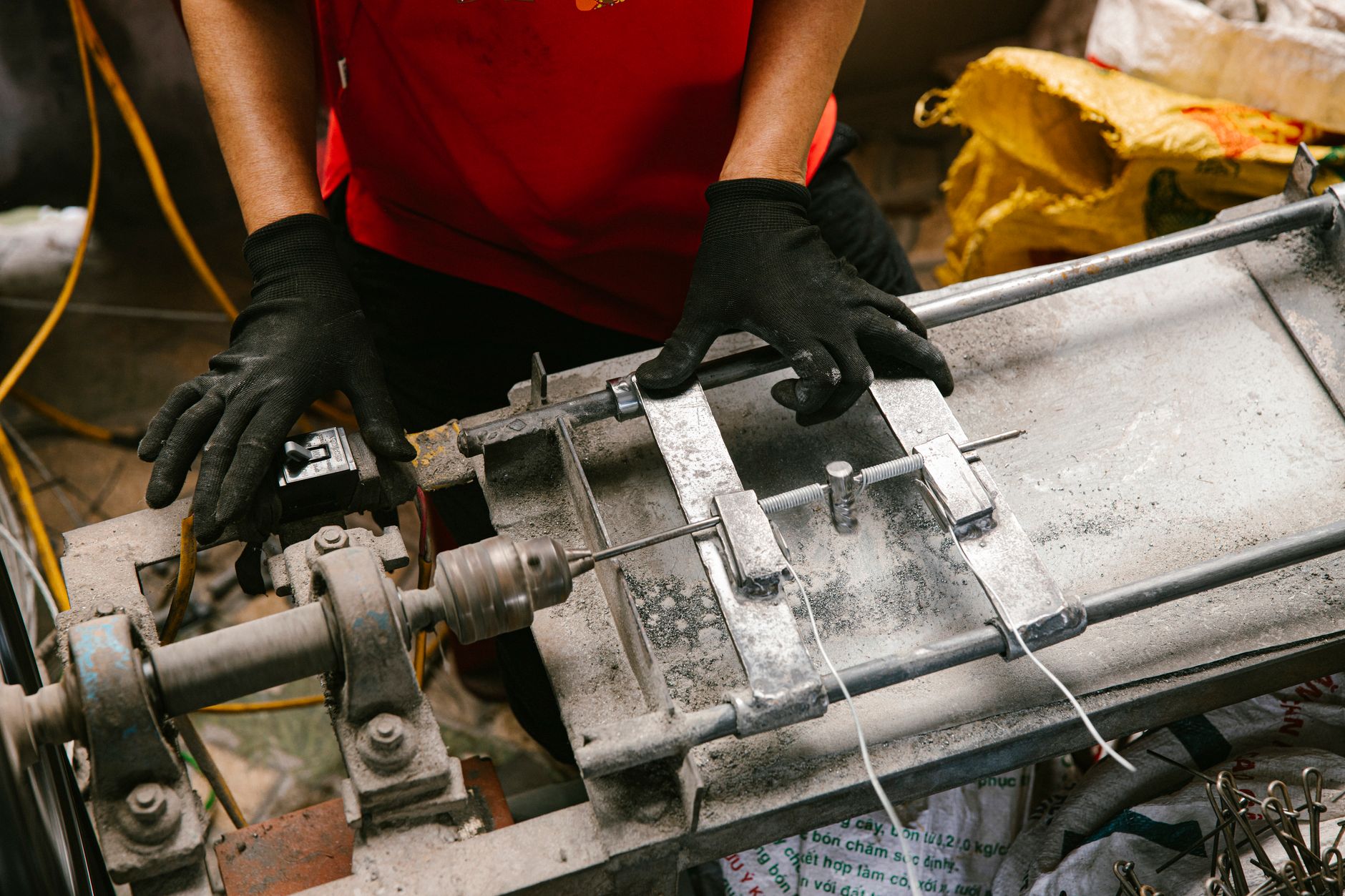
Fastening systems decide how long a removal takes. The fabric decides how long the cover lasts. Teams underestimate the first and obsess over the second.
Three families cover almost every industrial case.
Hook-and-loop closures
Hook-and-loop strips open fast and adjust to an imperfect fit. They suit clean environments and light dust. They also clog. In a foundry or a grinding cell, airborne particles fill the hooks within weeks and the closure stops gripping.
Industrial zips
A heavy-duty zip runs the length of a limb and opens the cover like a jacket. Zips give a tight, repeatable line and survive far more cycles than hook-and-loop. They dislike spatter: a weld bead on the teeth ends the zip. Protecting the zip under a storm flap solves most of that.
Snap fasteners and buckles
Snaps and buckles work where fabric must stay away from moving joints. They open one-handed, resist heat better than plastic zips, and let a technician release a single panel instead of the whole sleeve. Their weakness is sealing: a snap line is never airtight.
Our own rule is simple. Pick the fastening for the dirtiest thing in the cell, not for the average day.
Ducting ports: keeping pressure and heat under control
Some robots need air under the cover. Paint applicators need clean overpressure to keep solvent vapour out of the motors. High-temperature cells need a flow of cool air so the arm does not cook inside its own protection. A ducting port is the fitting that lets that air in and out through the cover, without opening a leak path for contamination.
A port has to do three things at once. It has to seal against the duct. It has to stay sealed while the arm moves through its full envelope. And it has to sit where the duct will not foul the cell.
Position matters more than the fitting itself. A port placed on axis 3 will drag its hose across the work envelope every cycle. The same port on the base plate stays still. We route ports on the least mobile section available, then let the fabric absorb the rest of the movement.
If you are comparing fabrics and environments before you get to fittings, our guide to robot covers with ducting port options and materials sets out which base fabric supports which environment.
Your cell needs air, not a compromise
Overpressure, extraction or cooling: we design the port, the seal and the routing around your duct, not around a catalogue part.
Discuss your cell →Inspection windows: reading the robot without undressing it

An inspection window is a transparent panel sewn into the cover. It lets an operator read a label, watch a grease point or check a leak without removing anything. On a robot that gets a visual check every shift, a window turns a five-minute job into a five-second one.
Windows have a real cost. The transparent material never matches the base fabric for chemical or thermal resistance, and it clouds faster. A window in a paint booth will fog within months. A window in a clean assembly cell will still be clear after years.
So we place them narrowly. One window over the thing that actually gets inspected beats four windows spread across the arm. Ask your maintenance team what they look at, not what they might look at.
Access panels for the things you touch
Where a window is not enough, an access panel is. A panel opens over a connector block, a grease nipple or an air fitting, then closes flat against the fabric. Technicians reach the point they need and leave the rest of the arm covered.
Panels beat windows whenever the task involves a tool. Windows beat panels whenever the task is purely visual.
Sensor-transparent and infrared openings
Vision systems, laser scanners and thermal sensors do not care about your cover. They need a clear optical path. Fabric blocks it.
Two answers exist. The first is a cut-out with a sealed transparent element chosen for the wavelength involved. Infrared robot protective covers need a material that passes the relevant band, which rules out most standard films. The second is a shaped opening that keeps the sensor cone clear while the fabric closes around it.
Both need the sensor position and its field of view before we cut anything. A cover designed from robot drawings alone will block a sensor that someone added after commissioning. Send us the cell as it runs, not as it shipped.
Which option for which constraint
| Need | Best option | What it costs you | Typical environment |
|---|---|---|---|
| Fast full removal for service | Industrial zip or buckles | Seal line is weaker than a closed seam | Assembly, machine tending |
| Frequent partial access | Access panel | Extra seams to inspect for wear | Welding, palletising |
| Visual check every shift | Inspection window | Window clouds before the fabric wears | Food, packaging, clean assembly |
| Clean overpressure or cooling | Ducting port | Hose routing must be planned | Paint, high temperature |
| Vision or thermal sensing | Sensor opening | Weakest point of the whole cover | Inspection, laser cutting |
| Maximum protection, rare access | None, sealed cover | Every intervention means removal | Foundry, chemical, ATEX zones |
What this looks like on real cells
Automotive welding: panels instead of full removal
An automotive supplier serviced six welding robots weekly. Each cover came off completely for a ten-minute check, then went back on. We rebuilt the covers with two access panels per arm, positioned over the points the team actually opened. Removal time per robot dropped by around 70%, and the covers lasted longer because the team handled them less.
Paint shop: the port that moved
A paint line ran covers with an overpressure port fitted mid-arm. The hose fouled the booth wall on every deep-reach cycle and the port tore twice in a year. Moving the port to the base and re-routing the duct along the fixed structure ended the failures. Same fabric, same port, different position.
Specifying options on a custom cover
Options are not accessories. They change the pattern, the seam layout and sometimes the fabric. Deciding them late means redesigning the cover.
Bring four things to the first conversation:
- the robot brand and model, so the pattern matches the real kinematics (Fanuc, ABB, KUKA, Yaskawa and Stäubli arms all move differently);
- the maintenance routine, task by task, with its frequency;
- the environment, including what lands on the cover and at what temperature;
- anything mounted on the arm after commissioning, sensors and dress packs included.
That last point catches most people out. Cables and hoses run outside the arm on many cells, and a cover has to accommodate them. Our guide to robot dress packs and cable protection covers how the two interact.
Different robot geometries also need different option layouts. A SCARA arm has almost no space for a panel where an articulated arm has plenty, which we detail in our breakdown of robot covers by robot type. For the difference between a full cover, a sleeve and a bellows, see our guide to industrial robot jackets and bellows.
Not sure which options your cell actually needs?
Request a free assessment →Access options by industry
The same option behaves differently from one industry to the next. A short tour of the cases we see most often.
Paint and spray applications
Spray booths need overpressure, so the ducting port is not optional. Windows fog quickly under solvent mist, so we keep them out of the spray zone. The base fabric handles the chemical load, the port handles the air, and the fastening stays outside the direct spray path.
Cleanroom and electronics
Particle control drives everything here. Every opening is a particle source, so a cleanroom cover carries the smallest number of them that the maintenance routine allows. Smooth closures beat hook-and-loop, which sheds fibres on every cycle.
Food industry
Washdown is the constraint. Panels and windows must survive daily cleaning with hot water and detergent, and every seam has to drain rather than hold liquid. Our food-grade covers use sealed closures for that reason.
Foundry, blast and heavy grinding
Corrosive dust, abrasive particles and radiant heat destroy delicate hardware. Zips clog, films degrade, and windows go opaque in weeks. In these cells the honest answer is often a sealed cover with one robust access panel, nothing more.
Aerospace and precision assembly
Measurement systems and vision sensors sit close to the tool, so sensor openings dominate the design. The optical path takes priority, and we build the rest of the cover around it.
Compatibility, lead time and what a custom manufacturer changes
Two questions decide whether a cover with options is a good investment. Does it fit your automation as it runs today? And can you get another one when this one wears out?
Compatibility is more than the robot model. It includes the tool, the dress pack, the fixtures around the cell and the clearance at full reach. A custom made cover answers all of that. A catalogue part matches the arm alone, which is why it fouls something on the third week.
Availability matters just as much. We manufacture in Toul, France, and we keep the pattern of every cover we deliver. A replacement uses the same pattern, with the same options in the same places, so a team never has to relearn a cover. Working with a manufacturer rather than a reseller is what makes that possible.
Flexible options also let a cover follow a cell as it changes. Adding a sensor next year is a pattern update, not a new project, provided the base design left room for it. Discussing that with your protection partner early is the cheapest way to improve the whole cell’s uptime.
Options and cover life
Every opening is a weak point. Seams around a panel wear faster than a plain panel of fabric. A window ages faster than the material around it. A port concentrates stress wherever the hose pulls.
None of that argues against options. It argues for putting them only where they pay for themselves. A cover with two well-placed openings outlives a cover with six decorative ones, and it protects better.
Watching those points is also the easiest way to catch wear early. Our guide on when to replace robot protection components sets out what to look for and how often. If the goal is uptime rather than the cover itself, see how protective covers reduce robot downtime.
Design choices upstream matter just as much: our page on industrial robot cover design explains which features to fix before manufacturing starts.
FAQ
They are covers built to be taken off, opened or vented without a full strip-down of the robot. Quick-release fastenings, access panels, inspection windows and ducting ports are the four features that make a cover removable in practice.
Each opening is a weaker point than plain fabric. A well-designed removable cover still protects a robot fully, because the openings sit where the environment is least aggressive and the seals are chosen for the actual contamination.
A ducting port is a sealed fitting that lets air pass through the cover. It supplies clean overpressure in paint applications, or cooling air in high-temperature cells, without opening a path for dust or solvent vapour.
On the least mobile section of the robot, usually the base or the lower arm. A port on a fast-moving axis drags its hose through the work envelope on every cycle, which tears the fitting and fouls the cell.
They pay for themselves when a visual check happens at least weekly. Below that frequency the window clouds or degrades before it has saved enough time to justify the weaker panel.
Industrial zips survive the most opening cycles in clean and moderately dusty cells. In foundry, grinding or heavy weld environments, snaps and buckles last longer because dust does not clog them and spatter does not destroy them.
Yes, with a sealed opening sized to the sensor cone or a transparent element chosen for the wavelength. Standard films block infrared, so you pick the material against the sensor specification, not against the fabric.
Rarely, and never well. Options change the pattern and the seam layout, so retrofitting one usually weakens the cover. Specifying the access needs before manufacturing costs nothing extra.
List every maintenance task on the cell with its frequency, then note what lands on the robot and at what temperature. Those two lists decide the fastening, the panels and the ports. Send them with your robot model and we size the cover around them.
Closure and opening names vary from one manufacturer to the next. The ones used here are defined in our technical glossary.
In Summary
Removable robot protective covers succeed or fail on their access options, not on their fabric alone. Quick-release fastenings decide how long a service takes. Ducting ports keep pressure and heat under control. Windows and panels let a team check and reach what matters. Sensor openings keep vision systems working.
Choose them against your real maintenance routine and your real environment. Two well-placed openings beat six convenient ones, every time.
Which access options does your robot actually need?
Send us your robot model, your maintenance routine and your environment. We come back with a cover specification built around them, at no cost.
Request a free assessment →Reviewed by René Domingues, founder of Robotic Cover Concept – a French manufacturer of custom robot protection covers since 1998, based in Toul, France, with units protected across Europe, Israel and Brazil.