In short. To specify a custom cover for a Fanuc robot, start from the exact series and model, then the environment, the wrist and tool, the cable route and the access you need. Those five points decide the pattern, the fabric and the closures. A model name alone is not enough, because two robots of the same series can sit in very different cells. Send them with photos and RCC can quote Fanuc robot covers made to measure. RCC has made custom protection in Toul, France, since 1998, and its covers protect robots across Europe, Israel and Brazil.
Table of Contents
Fanuc robot covers start from the series, not from the brand
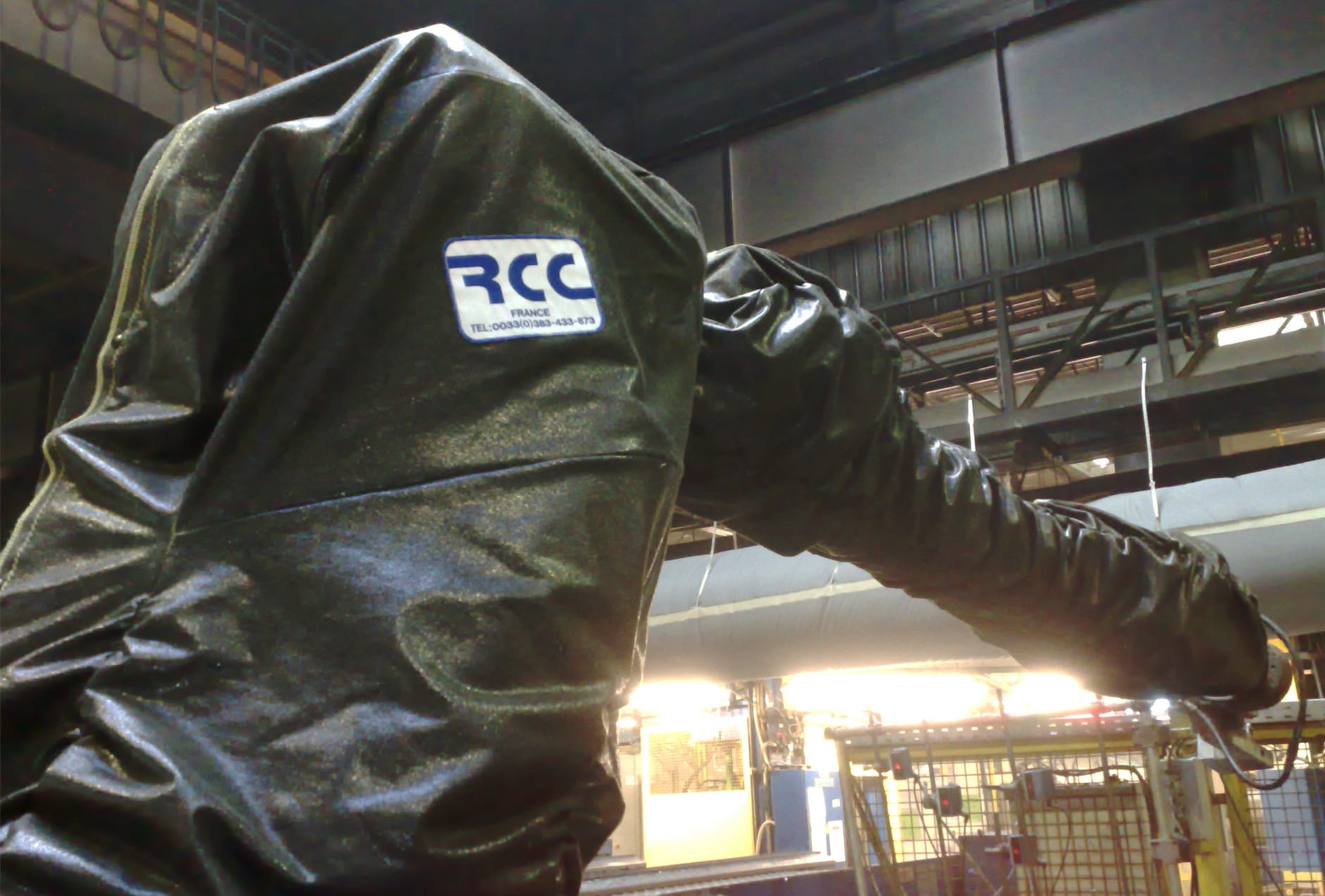
Fanuc is not one robot. The range runs from small LR Mate arms to heavy M-710, M-900 and R-2000 models, with collaborative CR and CRX arms, delta pickers and a full line of P-series paint robots. Each family has its own shape, its own wrist and its own cable exit. A pattern drawn for one does not fit another.
RCC already protects a long list of them. The Fanuc page lists the models, from the LR Mate 200iD and the M-10 and M-20 families to the M-710iC, M-900iB, M-1000 and R-2000iC, plus the P-series. If your model is on that list, the pattern work starts from a known shape. If it is not, send the nameplate and photos and our design office takes the measurements.
Whatever the Fanuc brand arm, most of them are 6-axis robots with a wrist that turns on three axes, so the same wrist questions come back. Some buyers call these products protective suits. We call them covers, and each one is cut for one robot.
A paint robot and a handling robot of similar size need different covers. The difference is not the arm. It is what lands on it.
| Fanuc family | What drives the cover design |
|---|---|
| LR Mate and small M-series | Tight wrist, little room for padding, cover must not limit joint travel |
| M-710, M-900, M-1000 and R-2000 | Large surface, long forearm, heavy dress pack, often foundry or machining |
| CR and CRX collaborative | Light fabric, no sharp closures, the arm works next to people |
| P-series paint | Overspray, solvent, static behaviour of the fabric, hazardous-area rules |
| Delta pickers | Washdown, hygiene, a cover that follows the moving arms |
Collaborative CRX and CR arms are a case of their own. A cobot cover is light, soft at the edges and easy to remove, and it must not hide what the operator needs to see or reach. The arm works near people, so the closures stay flat.
For the same question across other designs, see our guide to robot protective covers by robot type.
Read the environment: paint, foundry, welding or machining

The cell decides the material. In a paint booth the cover meets overspray and solvent, and it must not hold a static charge. In a foundry it meets radiant heat, scale and abrasive dust. See our guides to paint shop robot covers and to robot protection in foundries.
Welding is a third case. Spatter burns into a standard fabric within weeks, so the outer face needs a heat-resistant coating. Our guide to welding robot covers covers that choice, and the materials guide compares the fabrics.
Tell us the process, not only the sector. A hazard that is rare in one cell is daily in another. A machining cell with coolant mist and a cell with metal chips both count as machining, yet they ask for different seams. Coolant calls for a coated face, and metal chips call for an abrasion-resistant fabric.
Static electricity is the other point to raise. In a paint cell or near solvents, an anti-static fabric limits the charge that builds on the cover. Clean rooms and food lines pull the other way: the fabric must not shed, and it must be washable. Radiant heat, in a foundry or near a furnace, is a separate question and needs a heat-resistant coating.
If the cell is a classified area, say so at the first contact. The cover has to match the zone, as explained in our article on ATEX zones and protective covers.
Wrist, tool and dress pack: where a Fanuc cover is won or lost
Most cover problems on a Fanuc arm start at the wrist. The last axes turn the most, the tool hangs below them and the cables leave the arm at several points.
A good robot protective cover treats these points one by one. It leaves the tool flange free, lets the wrist reach its full travel and closes round the cable exit without a gap. The cover is customised to the arm, so the range of motion stays intact. A cover that is simply too tight pulls on every move. One that is too loose folds and rubs.
Tell us which tool is fitted and whether you change it. The robot cable run matters too, with its own cable protection where the arm bends. The dress pack matters too: cables and hoses running along the forearm can be inside the cover or outside it, with their own protection. Our article on robot dress packs and cable sheaths shows both options, and the guide to sleeves, bellows and jackets shows how they combine.
Bellows, sheaths and the teach pendant

A cover seldom works alone. A bellows protects a moving axis, a sheath protects a cable or a hose, and a case protects the teach pendant that lives on the cell door. RCC makes all of them, so the cover and its small parts are designed together instead of being bought from three suppliers.
The bellows, sheaths and teach pendant covers page lists the options. If the pendant leaves the cell with the operator, say how it is used and cleaned. A pendant that is wiped every shift needs a different case from one that stays on a hook.
Keep access for service: ask your supplier for closures
A cover that blocks service gets cut open on the shop floor, and then it protects nothing. Before the pattern is drawn, list what a technician must reach.
On a Fanuc arm that usually means the grease points, the backup batteries and the connectors on the arm. Our robot maintenance guide for Fanuc, ABB and KUKA explains the routine. The cover then has to give access to those points: a zip, a hook-and-loop flap or a panel, as shown in our article on removable robot protective covers.
A cover has a service life as well. It wears first where the process hits it, so plan its inspection with the robot’s own service.
What to send for a quote
The more you send, the fewer questions come back. Four items do most of the work.
The robot. Series, model and year if you have it, and a photo of the nameplate. Say if the arm has been repainted or modified.
The cell. The process, the fluids and the temperature you expect, and where the current protection fails. A worn cover is the most useful sample you can send.
The wrist and the tool. Photos from three sides of the wrist, the tool and the cable exits, with the arm in its home position.
The access. What must stay reachable and how often. For measuring a machine and sending the right data, our guide to how to measure and specify a machine for a made-to-measure cover shows the method, and the sizing and fitting guide covers the arm.
We then propose a pattern, a fabric and a closure set. On request we install the cover on site, and we repair or replace it later. See installation and repair. Our covers are made in France, so a change after the first fitting takes days, not months.
Protection while the robot is stored or idle
A robot that waits for its cell, or sits in storage between two jobs, also needs protection. Dust, damp and a splash from a nearby process settle on bare joints. A storage cover is simple and light. It is worth ordering when a robot stays unused for more than a few weeks.
FAQ
Specifying the cover
The series and model, a photo of the nameplate, the process and fluids in the cell, photos of the wrist, tool and cable exits, and the points you must reach for service. With those, a design office can propose a pattern and a fabric.
No. Two robots of the same model can work in a paint booth or in a foundry, with a different tool and a different cable route. The model gives the shape, the cell gives the material.
Yes, as long as we can measure the arm. If your model is not on our Fanuc page, send the nameplate and photos and our design office takes the measurements.
Fit and service
It should not. The pattern is drawn so that every axis reaches its full travel, and the fit is checked on site during installation.
Through closures planned in the pattern: a zip, a flap or a removable panel. List the points you need at the briefing, so they are built in and nobody has to cut the cover.
Yes. Bellows, sheaths, teach pendant covers, cuffs and storage protection are part of the same range, and we design them together with the cover.
In Summary
A Fanuc cover fits well when it starts from the series, follows the environment, respects the wrist and the cable route, and leaves the service points open. A good supplier asks for them before quoting. Send those five elements with photos and the quote comes back with a pattern, a fabric and a closure set, not a catalogue reference.
Browse our range of Fanuc robot covers, or read the Fanuc, ABB and KUKA maintenance guide. Working on a KUKA cell? See our companion guide to KUKA robot covers. Our technical glossary defines the terms used above.
Ready to specify a cover for your Fanuc robot?
Send us the model, the nameplate and a few photographs of the arm and the cell. Our design office prepares a made-to-measure cover, with a free assessment.
Request a free assessment →