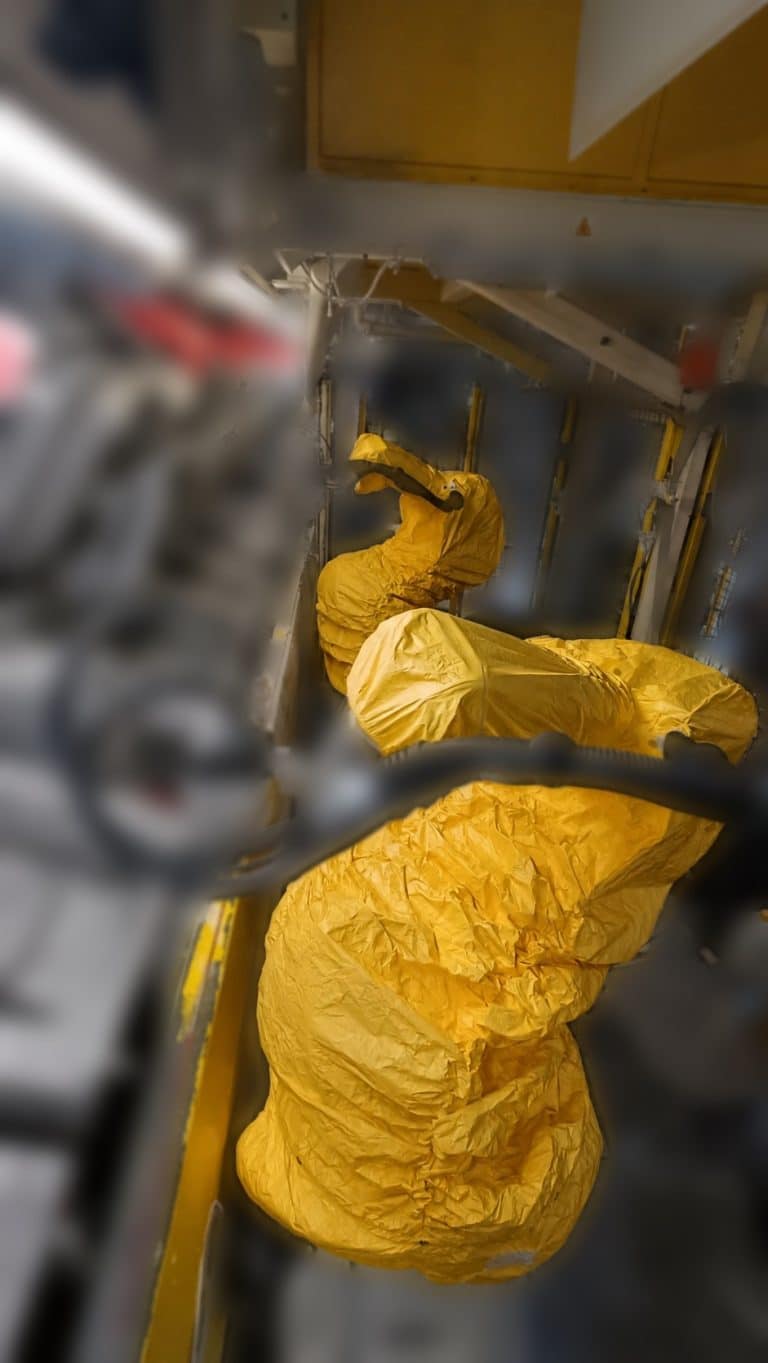
In short. KUKA robot covers must follow the arm axis by axis and leave the dress pack, the ports and the service points free. The right fabric depends on the cell, not on the KUKA series. A foundry, a welding cell and a washdown line each ask for something different. Covers cut to the real arm and the real cabling last longer than a standard cover. We are a supplier of protective covers for industrial robots. We make custom protection for the whole KUKA range at RCC, in Toul, France, since 1998.
This page helps you prepare a request for KUKA robot covers. It lists what a robot protective cover has to account for, and what to send us. For the models we already protect, see our KUKA robot covers page. The same approach applies to other brands: our sister guide covers Fanuc robot covers.
Table of Contents
Start with the robot arm: six axes, six different movements

A KUKA 6 axis industrial robot numbers its axes A1 to A6. Each one asks something different of a cover. The base and the first axis turn the whole arm, so the cover must not catch on the floor or the fixtures. Next, the rocker and the arm travel in wide arcs, and the fabric has to fold without tearing. Last comes the wrist. It turns the most and sits closest to the process, so it takes the heaviest load.
A robot cover that fits at rest can still fail in motion. The cut must be checked at the end of each axis travel. That is why we pattern a cover on the real arm, or from its exact dimensions and working positions, not from a catalogue size. Our page on robot covers by robot type explains how articulated arms differ from SCARA and delta robots.
Know your KUKA family before you ask for a quote
The covers do not depend on the name alone, but the series tells us a lot about the arm. KUKA lists compact robots such as the KR AGILUS, mid-range robots such as the KR CYBERTECH and the KR IONTEC, and heavy-payload robots such as the KR QUANTEC and the KR FORTEC. A small arm leaves little room around the wrist. A heavy arm has long, large segments and a heavy dress pack to wrap. Both need a different pattern.
Some robots also come in variants built for harsh cells. On its KR QUANTEC page, KUKA lists a Foundry version (suffix F) and a Food version (suffix HO), and rates the listed models IP65 and IP67. That rating describes the robot itself. It says nothing about the hoses, the connectors and the pendant cable that run outside the arm. A cover still has a job to do on a Foundry or HO robot, because the cell around it stays hard on paint, cabling and wear parts.
The dress pack: the part most covers get wrong

KUKA calls it the energy supply system. Many plants say dress pack. It is the set of hoses and cables that run along the arm to feed the tool. On a robot that works every shift, these lines bend, twist and rub on every cycle. A cover that squeezes them shortens their life. A cover that leaves them bare loses most of the point of the protection.
Three choices come up on every KUKA project. The dress pack can run inside the cover, under its own sleeve or bellows. It can also run outside, with openings and strain reliefs in the cover. Many projects mix both, depending on the axis. Which one works depends on how the lines are routed and what reaches them. Our guide to robot dress packs and cable protection shows the failure modes. For the hoses themselves, see the page on protective sleeves for robot hoses and cables.
Let the environment pick the fabric of the robot cover
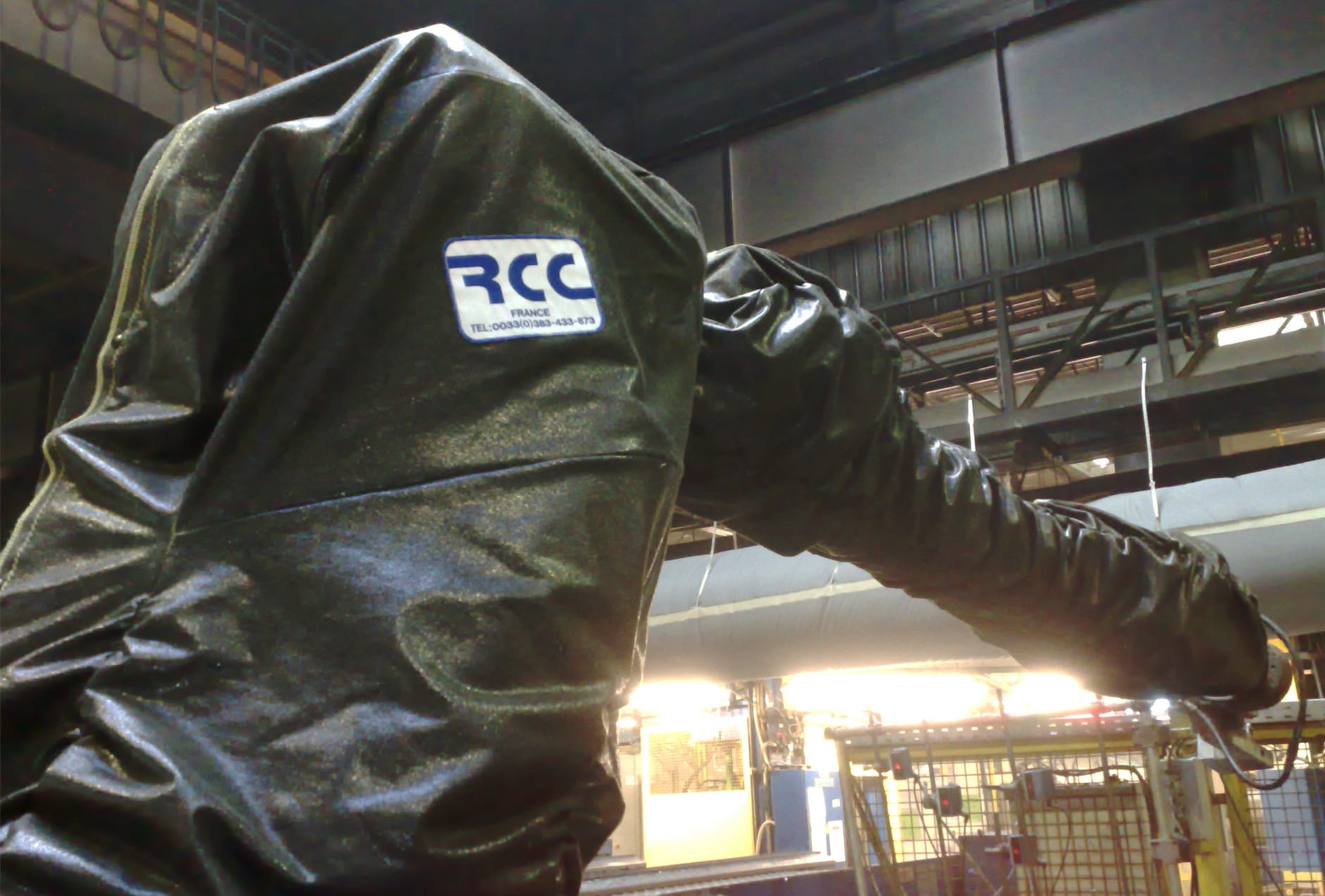
The same KUKA robot arm needs a different cover from one plant to the next, whether it sits in industrial automation or in robotics R&D. A foundry throws heat, dust and metal splashes. In a welding cell, weld spatter lands on the wrist. Overspray sticks and builds up in a paint booth. On a washdown line, water and cleaning products hit the arm all day long.
List what actually touches the robot before you choose a fabric. Add the hottest point, the nearest process, and the fluids in the cell. We pick the fabric and the coating from this list, not from the robot make. Our custom robot protective covers suit welding robot arms, painting robot cells, palletizing and machine tending alike. Our page on robot protective materials compares the families. For welding cells, the fitting and welding range shows what we build against spatter.
Keep the service points reachable
A cover that nobody can open gets cut off on the first service day. A cover that opens too easily lets dirt in. The balance comes from the closures and from where the openings sit. Tell us which points the maintenance team reaches often, such as connectors, the grease points and the axis marks. We can then design access panels, inspection windows or fast-release sections where the crew needs them. The page on removable robot protective covers goes through the options.
The service plan of the robot also sets the rhythm. If your KUKA arm follows a defined maintenance routine, our maintenance guide by brand sets out what changes from Fanuc to ABB to KUKA. The cover should never be the reason a check is skipped.
Do not forget the teach pendant and the wrist tools
The robot is not the only part that wears. The teach pendant gets dropped, splashed and handled with dirty gloves. On KUKA robots this is the smartPAD. A protective cover for the pendant and its cable costs little next to a damaged screen. We make covers for teach pendants and consoles, as well as bellows and sheaths, as shown on the bellows, sheaths and teach pendant covers page. We also protect the tools at the end of the arm, as long as the cell calls for it.
What this looks like in a cell
Picture a plant that welds frames with several KUKA robots in a row. Spatter lands on the wrist and the dress pack of each one. A standard cover gets holes after a few weeks, and the crew tapes over them. A cover with a heavier outer face on the torch side, a sleeve over the dress pack and a quick opening at the connectors stays in place and lets the technician reach what he needs.
Or take a foundry cell with a heavy arm that handles hot parts. Heat and dust matter more than spatter. The cover uses a heat-resistant outer layer, seams placed away from the hottest zone, and a pattern that follows the arm at full stretch. These are generic scenarios, not results from a named customer. The gain depends on each cell.
What to send us for a quote
A short file is enough to start. We can then tell you what is feasible and give you a price.
- The robot make, the series and the exact model, as written on the plate
- The mounting position: floor, ceiling or wall
- Photos of the whole arm and of the wrist, plus the dress pack route
- The environment: heat, spatter, paint, fluids, dust, washdown
- The points that need access: connectors, grease points, pendant
- The cover you use today, and where it fails first
If you have a worn cover, send a photo of it. The way it wears tells us more than a data sheet. We also handle installation and repair, so you can ask us to fit or renew the covers on site.
A KUKA robot to protect?
Send us the model, the environment and a few photos of the arm. Our design office replies with a cover cut to your robot.
See our KUKA robot covers →FAQ
We make made-to-measure covers for the KUKA models listed on our KUKA page, and for others on request. Send the model and a few photos, and our design office tells you what is feasible.
Often yes. The IP rating of the variant applies to the robot. The hoses, the connectors, the paint and the pendant cable stay exposed to the cell, and a cover protects those parts.
It is the set of hoses and cables that run along the arm to the tool. KUKA calls it the energy supply system. A cover must follow it, not squeeze it.
A standard cover can fit a robot at rest. It rarely follows the arm at full travel, and it often blocks the dress pack or the service points. A pattern made on the real arm avoids this.
The model, the mounting position, photos of the arm and the wrist, the environment and the points that need access. A worn cover, if you have one, helps a lot.
Yes. We make covers for teach pendants and consoles, and bellows and sheaths for the cables.
Yes. We handle installation and repair, so a technician can fit or renew the covers at your plant.
In Summary
KUKA robot covers work when they follow each axis, respect the dress pack and open where the crew needs access. The environment sets the fabric, the arm sets the pattern. A short file with the model, photos and a list of what touches the robot is enough to start.
See the models we cover on our KUKA robot covers page. For the same topic on another brand, read our Fanuc robot covers guide. Our technical glossary defines the terms used above.
Ready to protect your KUKA robots?
Send us the robot model and a few photographs of the cell. Our design office prepares a made-to-measure cover, with a free assessment.
Request a free assessment →