
In summary: a protective cover has to match the kinematics of the robot, not only the environment it works in. SCARA robot protective covers concentrate on the exposed vertical Z axis, the one part the manufacturer leaves uncovered. Articulated six-axis arms need sleeves on the links and folded components at the joints. Delta pickers need light, sealed covers that survive washdown without adding mass. Cobots need a thin skin that stiffens no joint and creates no pinch point.
Two robots can share a cell, breathe the same dust and run the same shifts. They will still need different protection. One is a six-axis arm whose wrist sweeps through a wide arc. The other is a SCARA whose vertical shaft plunges up and down a few hundred thousand times a year. A cover cut for the first fails on the second within weeks.
Most protection catalogues sort covers by environment: welding, foundry, paint, food. That answers half the question. The other half is kinematics. It tells you where the arm moves, where it stays still, and which surface a contaminant reaches first. Get the environment right and the robot type wrong, and the cover either tears at a joint or blocks it. Either way you lose production time on a cell that ran fine yesterday.
There are now 4,664,000 industrial robots in operational use worldwide, 9% more than the year before, according to the International Federation of Robotics. That parc no longer looks uniform. Articulated arms, SCARA units, delta pickers and collaborative robots now share the same halls. Each one wears out its protection differently.
In summary
An articulated six-axis robot needs its links and its joints treated separately. A SCARA robot needs a shroud on the vertical ball screw before anything else. A delta robot needs a light cover that survives washdown. A cobot needs protection that adds no rigid mass and leaves its force sensing intact. RCC has patterned covers per robot model since 1998, from its workshop in Toul, France, for Fanuc, ABB, KUKA, Yaskawa and Stäubli machines now running in Europe, Israel and Brazil. One electronics case below: shrouding the SCARA vertical axis cut related stoppages by an estimated 70% over a year.
Table of Contents
Why the Robot Type Decides the Cover, Not Just the Environment
A protective cover has one mechanical job. It must seal against the process, and it must follow the machine through its full envelope. Those two demands pull in opposite directions. Where the compromise lands depends on the geometry underneath.
On an articulated arm, the joints cause the difficulty. A SCARA concentrates it on one exposed linear shaft. With a delta, three parallel arms and a set of ball joints barely tolerate extra weight. And a cobot moves the difficulty away from mechanics altogether, into the safety function.
This explains why a generic kit rarely survives. Cut the pattern for the wrong kinematics and the fabric bunches where the machine folds. It stretches where the arm extends. It abrades against itself long before the production environment gets a chance to damage it. How the cover is cut, closed and reinforced therefore matters as much as the textile. We go through those choices in our guide to industrial robot cover design.
Articulated Six-Axis Robots: Links, Joints and the Wrist
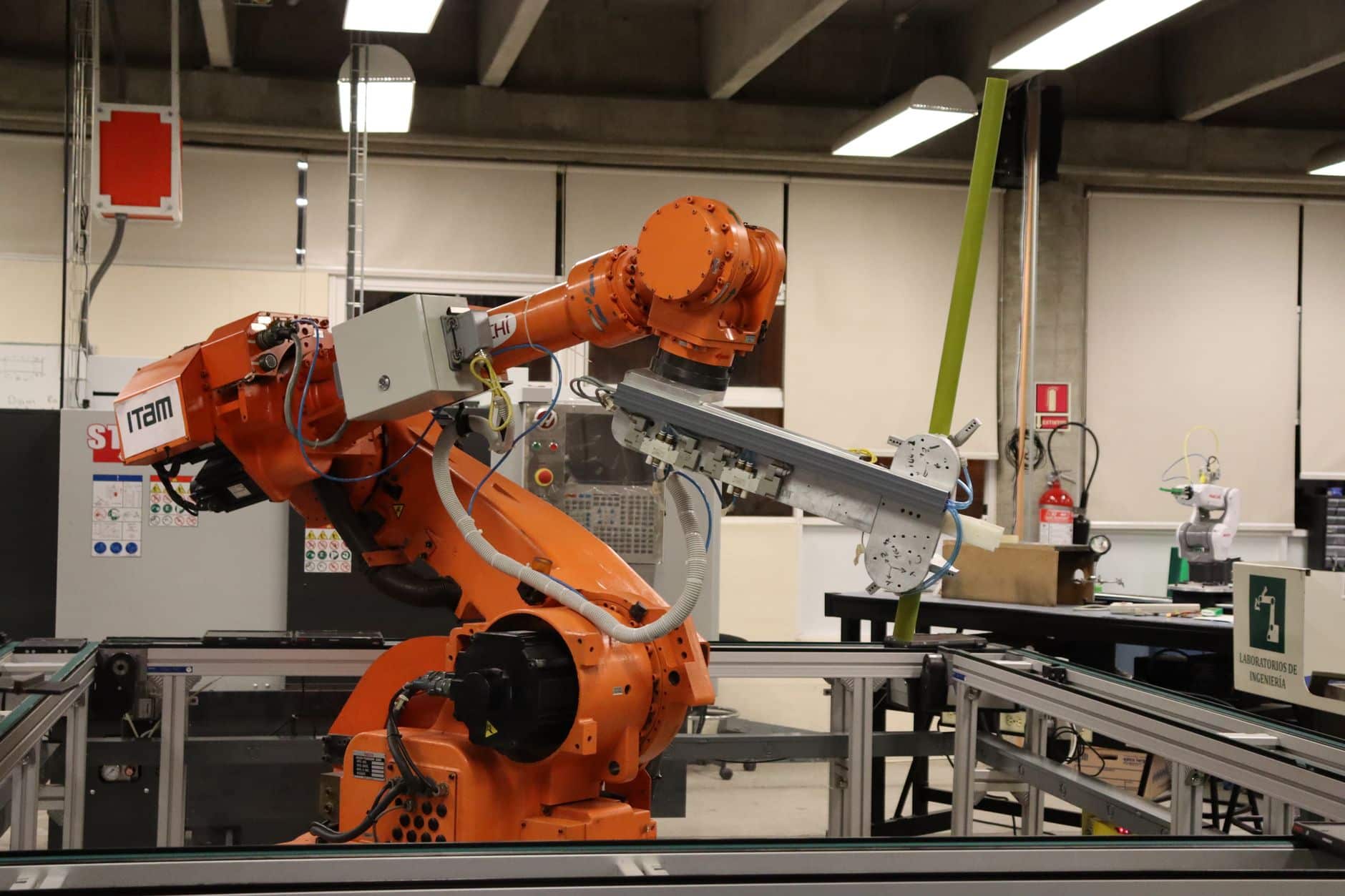
The articulated arm remains the workhorse of industrial automation, and the best documented case. Its long rigid links barely flex. Axes 2 and 5 rotate constantly through a wide range. Covering both with the same panel of fabric is the specification mistake we correct most often.
Sleeves on the links, folded components at the joints
A working assembly combines three things. Each straight link takes a sleeve. At every joint that has to absorb travel, a folded component does the work. And when the whole arm faces one hazard, a full jacket takes over. Our guide to robot sleeves, bellows and jackets sets out what each piece does and where it belongs.
The wrist and the cable bundle
The wrist deserves separate attention. Axes 4 and 6 rotate the tool flange through the highest cycle count on the machine. The end of arm tooling drags the cable and hose bundle along with it, which turns cable routing at the wrist into a design decision rather than an installation detail. On a welding cell, that bundle is where spatter finds its way in. We treat it as its own problem, not as an accessory to the arm cover.
Not sure what your robot model actually needs?
We pattern protective covers per robot model and per axis, for Fanuc, ABB, KUKA, Yaskawa and Stäubli machines, and we match them to the production environment they work in.
See our protection ranges →SCARA Robots: the Vertical Axis Is the Weak Point
SCARA robots handle fast, repetitive assembly in electronics and pharmaceutical packaging. They also turn up on automotive and aerospace subassembly lines. Their two horizontal links come almost fully enclosed from the manufacturer. One element stays exposed: the vertical Z axis, a ball screw and spline shaft that travels up and down uncovered on almost every model.
Why the Z axis fails first
That shaft attracts contamination. Any particle landing on it rides straight into the bearing and the screw thread on the next stroke. Abrasive dust, machining debris, glue mist, flux residue and solvent aerosols all attack the drive rather than the surface. The failure therefore shows up as positioning drift, long before anything looks damaged.
What effective SCARA robot protective covers look like
They start with a folded shroud over the Z axis. It has to match the full stroke. It also has to stay light, because that drive never had to pull anything. Fanuc SR-3iA and SR-6iA class machines share this constraint, and so do the Stäubli SCARA units used in cleanroom work. The shroud must compress fully at the top of the stroke without bunching against the tool.
The horizontal links usually need nothing more than a wipe-clean shield over the elbow. Overhead spray or high-pressure washdown changes that. In those cells we seal the whole upper body and add a cuff at the shaft, so nothing can track down the exposed portion.
Delta Robots: Light Covers, Sealed Joints, Washdown Duty
Delta robots run at speeds where every added gram counts. Three light arms hang from an overhead base, connected by ball joints. They move fast enough that a loose cover becomes a hazard in its own right. You find them in food packaging and pharmaceutical picking, where operators wash the cell down at the end of every shift.
Two constraints follow. The cover has to stay light and close-fitting, because mass at the end of a delta arm eats directly into cycle time and accuracy. It also has to seal properly. A washdown cycle at pressure pushes water into any seam that merely folds shut.
So we protect a delta as one enclosed volume rather than as separate pieces. The base and motors sit under a sealed hood. Slim close-cut sleeves go on the arms. A wipe-clean skirt finishes the tool plate. Food-grade fabric and thread are non-negotiable here, a point we develop in our article on protective covers for robots in the food industry.
Cobots: Protection That Does Not Blind the Safety Function

A collaborative robot is the one case where a protective cover can create a safety problem instead of solving one. Cobots work near people because they detect contact and stop. That detection depends on joint torque sensing, and on an arm with no hard edges or trapping points.
Three rules for a cobot cover
First, keep the added mass minimal. The safety limits rest on the arm’s own inertia. Second, never stiffen a joint. A folded component that resists movement looks to the controller like an obstacle, so the robot either stops constantly or needs higher thresholds, which defeats the point. Third, create no pinch point between fabric and structure.
A thin, flexible skin does the job. It follows the arm closely, uses soft closures rather than rigid fasteners, and leaves no exposed hardware at the joints. Cobots handling glue, oil mist or fine dust are the usual candidates. The covers protect the machine, keep cleaning down to a wipe, and leave the collaborative behaviour untouched. Before any protection change goes back into production, re-validate it against the cell’s own risk assessment.
Cover Requirements at a Glance, by Robot Type
The table below summarises what each family exposes, and what a working protection assembly looks like.
| Robot type | Most exposed element | Protection that works | Main constraint |
|---|---|---|---|
| Articulated six-axis | Axes 2 and 5, wrist, cable bundle | Sleeves on the links, folded components at the joints, full jacket in harsh cells | Follow a wide envelope without loading a joint |
| SCARA | Vertical Z axis (ball screw and spline) | Folded shroud over the full stroke, cuff at the shaft, shield on the elbow | Compress fully without bunching or adding drag |
| Delta | Ball joints, motor base, tool plate | Sealed hood on the base, slim sleeves on the arms, wipe-clean skirt | Minimum mass, watertight under washdown |
| Collaborative (cobot) | Joints and any added hard point | Thin flexible skin, soft closures, no exposed hardware | Preserve force sensing, create no pinch point |
What Standard Kits Miss, and What Changes on the Line
Off-the-shelf protection targets the most common case: a mid-size articulated arm in a dry environment. Everything else gets an approximation. That approximation is where the service life goes.
| Point of comparison | Standard kit | Cover patterned per robot model |
|---|---|---|
| Fit to the axis | One size for a family of models | Cut to the actual travel of each axis |
| SCARA vertical axis | Often left uncovered | Shroud sized to the full stroke |
| Delta mass | Fabric weight not a design input | Weight budgeted against cycle time |
| Cobot safety | Rigid fasteners, added stiffness | Soft closures, force sensing preserved |
| Pass-throughs | Cut on site, sealed with tape | Openings for cables and pneumatic fittings built into the pattern |
An electronics line losing accuracy every few months
An electronics manufacturer ran SCARA units on a dispensing line. Positioning drift kept coming back. The vertical shafts were bare, and adhesive mist settled on them between cycles. We fitted shrouds cut to the full Z stroke. The customer then reported an estimated 70% drop in stoppages linked to that axis over the following year, with no change to cycle time.
A food line losing covers to the washdown
On another site, a food packaging line with delta pickers kept destroying covers. The daily washdown did the damage, not the process. The seams folded shut instead of sealing, and water tracked into the motor base. We rebuilt the hood as a single sealed volume. The replacements stopped, and the covers now come off only for the scheduled inspection.
Covers already fitted but wearing out too fast?
See our installation and repair service →Specifying a Protective Cover for Your Robot Type
A usable brief holds four things. Name the exact robot model and its reach. List the axes your cell actually exposes. Describe the hazard at its worst, not on average. Then state the cleaning regime. Briefs leave out that last point more often than any other, and it causes more premature failures than the process itself.
Two details deserve an explicit line. Build every opening for cables, hoses or pneumatic fittings into the pattern rather than cutting it on site, because a taped opening lets contamination in first. And give the cable and hose bundle its own entry, since on most machines it fails before the arm cover does. Our article on robot dress packs covers that failure mode.
The material follows from all of this rather than leading it, and it sets the durability and the reliability of the finished component. Settle the geometry and the cleaning regime first. The choice between a high-temperature, chemical-resistant or food-grade textile then becomes straightforward, and we go through it environment by environment in our guide to robot protective covers. Knowing when to replace a worn component keeps the assembly working for the life of the cell.
FAQ
Yes. The environment decides the fabric, but the kinematics decide the shape. A cover patterned for an articulated arm bunches on a SCARA and adds too much mass on a delta, so it fails for mechanical reasons before the process ever damages it.
The vertical Z axis. The ball screw and spline shaft are exposed on almost every model, and any particle settling on them is carried straight into the drive on the next stroke. That is where SCARA robot protective covers pay for themselves fastest.
It can, if it is specified without a weight budget. Mass at the end of a delta arm costs cycle time and accuracy directly, which is why delta covers are cut close and kept light rather than built like an articulated arm jacket.
A badly chosen one will. Collaborative robots rely on joint torque sensing, so a cover that adds mass or stiffens a joint gets read as contact with an obstacle. A thin, flexible skin with soft closures avoids this, and any change should be re-validated against the cell’s risk assessment.
Usually axis 5, the wrist bend, followed by axis 2. Both flex through a wide range on every cycle, so a component that merely covers them without following their travel tears at the fold line first.
On a mid-size articulated arm in a dry environment, often yes. Outside that case they approximate, and the approximation shows up as early wear at the joints, taped pass-throughs and covers that have to be replaced several times a year.
Yes, provided the fabric and thread are specified for it and the shroud is closed rather than folded. The point in a cleanroom is as much to stop the robot shedding particles as to protect it from the room.
Rarely with good results. Reach, axis travel and flange geometry differ between models even inside the same family, so a transferred cover tends to be tight at one joint and slack at another. We pattern per model for that reason.
Speed is not what damages them. Glue, oil mist and fine dust reach a slow arm exactly as they reach a fast one, and cobots are often the machines closest to the messy end of the process. The protection just has to be lighter and softer.
The names given to each robot family, and to the protection components that go with them, are defined in our technical glossary.
In Summary
Most people discuss robot protection as a question of fabric. The environment does tell you which fabric to use. The robot type tells you where to put it. An articulated arm needs its links and its joints treated separately. A SCARA needs a shroud on its vertical axis before anything else. Light and watertight defines the delta. And a cobot needs protection that its safety function never notices.
RCC has designed and manufactured custom robot protection in France since 1998, patterned per model rather than per family, for machines working across Europe, Israel and Brazil. If you are not sure which of these four cases your cell falls into, have that conversation before ordering anything.
Which robot type are you protecting?
Send us the model, the environment and a photo of the cell. We come back with the components that fit, and the ones you do not need.
Request a free audit →Reviewed by René Domingues, founder of Robotic Cover Concept – a French manufacturer of custom robot protection covers since 1998, based in Toul, France, with units protected across Europe, Israel and Brazil.