In short. A fire sleeve slips over a hose or cable bundle and shields it from weld spatter and radiant heat. On a welding robot the sleeve has a harder job than on a fixed hose. The bundle bends and twists, and it sits a few centimetres from the arc. Damage usually starts at the torch end of the dress pack, so that is where protection pays off first. A catalogue fire sleeve is enough for a short static run. Once the bundle moves with the wrist, a sleeve cut to the robot’s route lasts longer and holds its position. RCC has made custom protection in Toul, France, since 1998, and its covers protect robots across Europe, Israel and Brazil. This guide shows where a welding cell burns a dress pack and what a fire sleeve changes. It also explains how to tell when a sleeve needs replacing.
Table of Contents
Where spatter and heat reach the hose and cable bundle
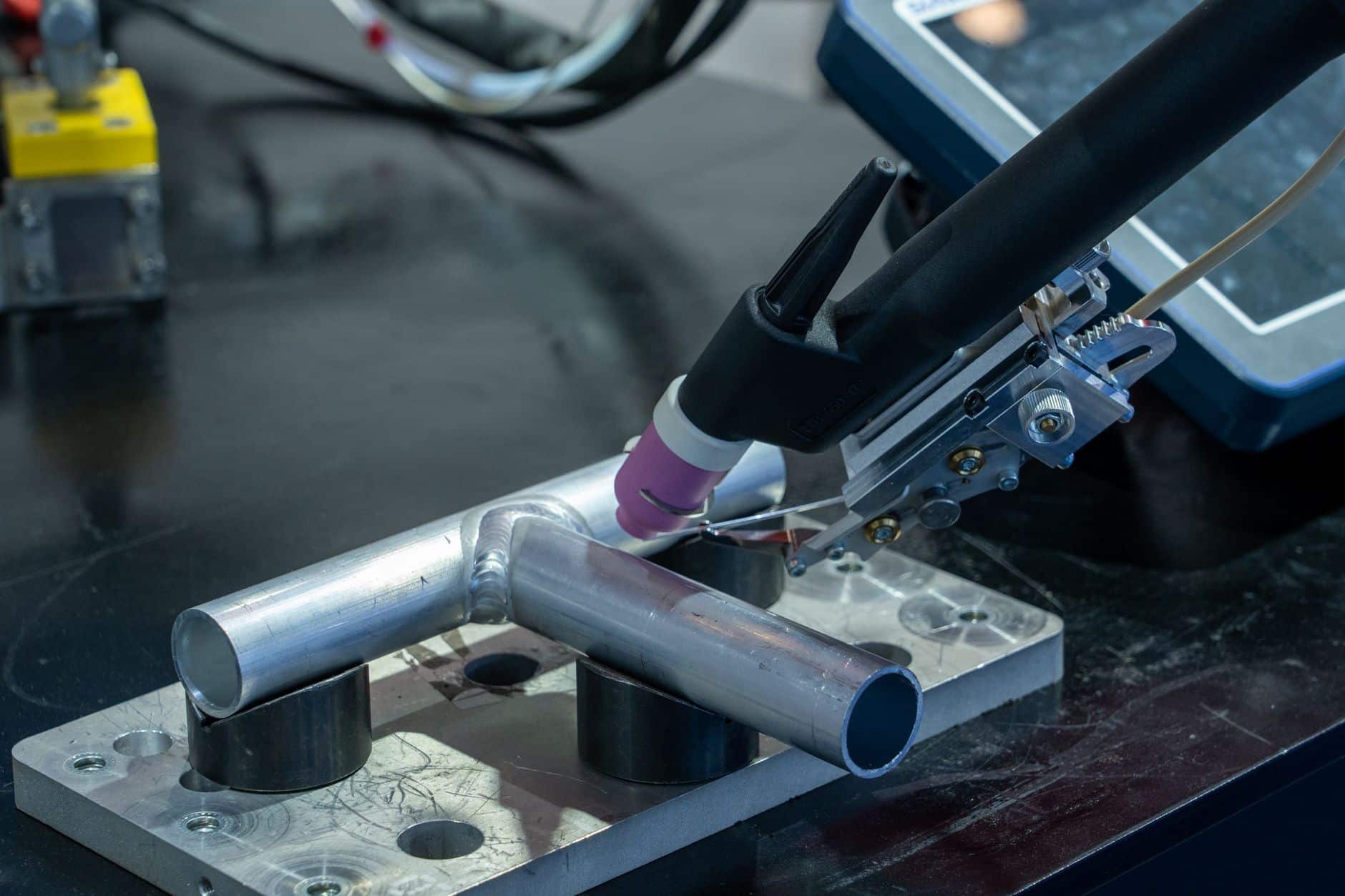
The dress pack of a welding robot carries power, wire feed, shielding gas and signals along the arm to the torch. Its exposure varies along the length. The last half metre before the torch sees the most. Spatter leaves the weld pool in every direction, and the bundle sits close to it. Further back, the threat shifts from direct hits to radiant heat, plus dust and fumes that settle on the jacket.
Three places burn first. The torch neck takes direct spatter. At the wrist loop, the bundle bends tightest, so spatter and flexing work together and a softened jacket cracks at the fold. The underside of the arm collects falling spatter, which lands and sits on the sleeve instead of bouncing off. We see this pattern from cell to cell, whatever the robot make. Our guide to robot dress packs explains how the bundle is built. The page on cable management failure modes covers the mechanical side of the wear.
Spatter lands further from the weld than most crews expect
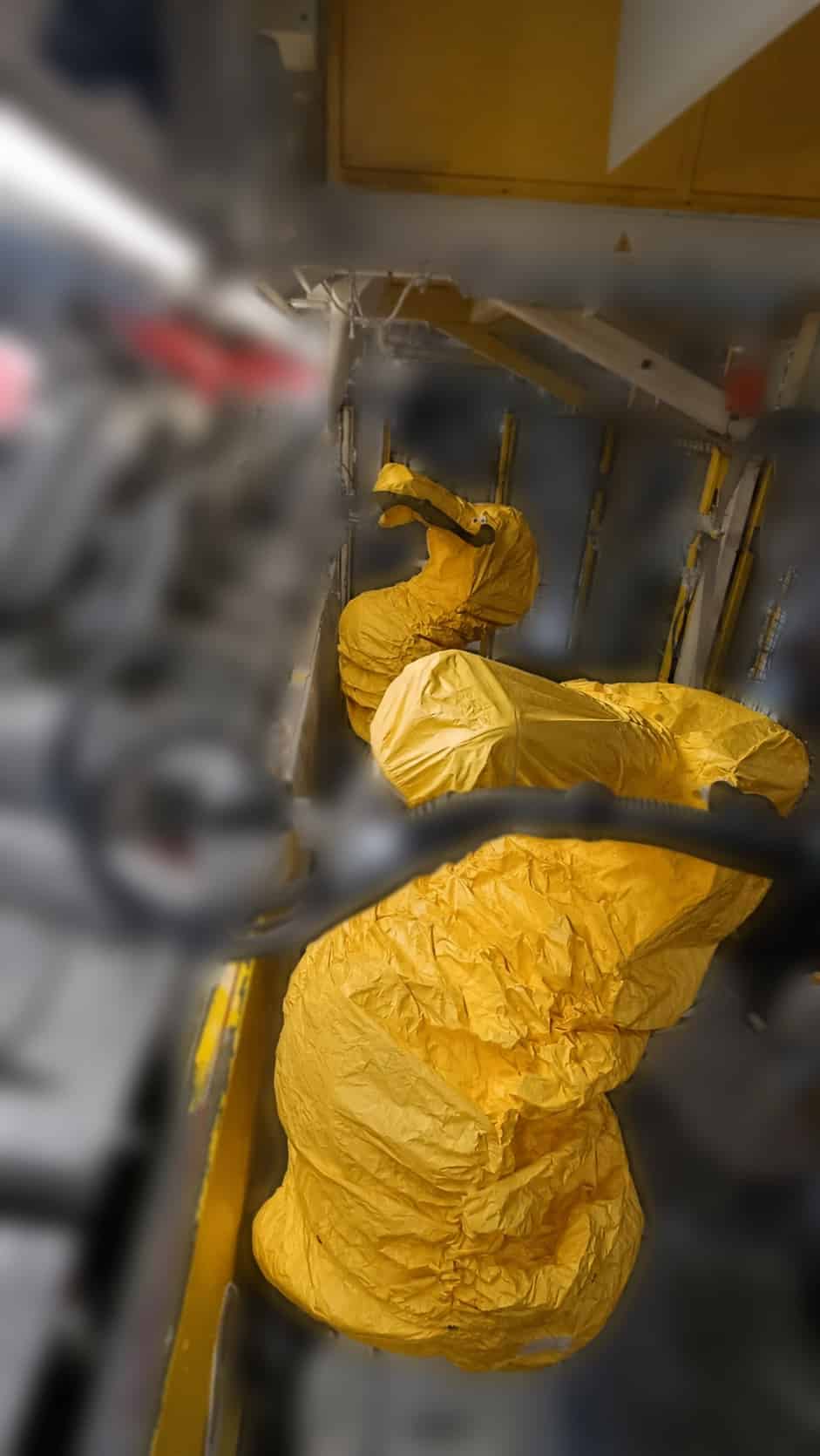
A spark shower is wider than the weld that produces it. Droplets fly off at different angles and speeds, and the larger ones carry enough energy to stick where they land. On a robot, the arm, the torch cable and the fixtures all sit inside that shower for the whole cycle. The dress pack never gets a break from it, unlike an operator who steps back between welds.
This is why the position of the bundle matters as much as its fabric. A dress pack routed on the side of the arm that faces the weld takes far more hits than one routed on the far side. When we survey a cell, we note which way the torch points during the longest welds, because that tells us which face of the sleeve takes the load.
What a fire sleeve changes, and what it does not
A fire sleeve is a fabric tube with a flame-resistant face, often a fiberglass base with a silicone or similar coating. It sheds or absorbs spatter that would otherwise melt into the cable jacket or the hose wall. Buyers also search for a heat resistant sleeve or a heat shield sleeve. The question behind all three is the same: what keeps the hose alive next to a weld. Flame resistance and heat protection are the two properties that matter here. The sleeve stops molten droplets from sticking to the jacket. It adds insulation against radiant heat. Last, the sleeve keeps the cable underneath clear of the next hit.
A sleeve cannot fix a badly routed bundle. It will not stop a hose rubbing on the arm. For that wear, see our guide to a hose protection sleeve for robot cells. It cannot relieve a bundle pulled tight at the wrist. Spatter damage also builds up over time. Every sleeve eventually takes hits it cannot shed, so replacement intervals matter as much as the choice of fabric. Abrasion resistance, oil and coolant splash and the flexibility of the fabric all play a part too. We keep the detail on fabric families in one place: our page on robot protective materials.
Why a standard fire sleeve slips on a robot hose bundle
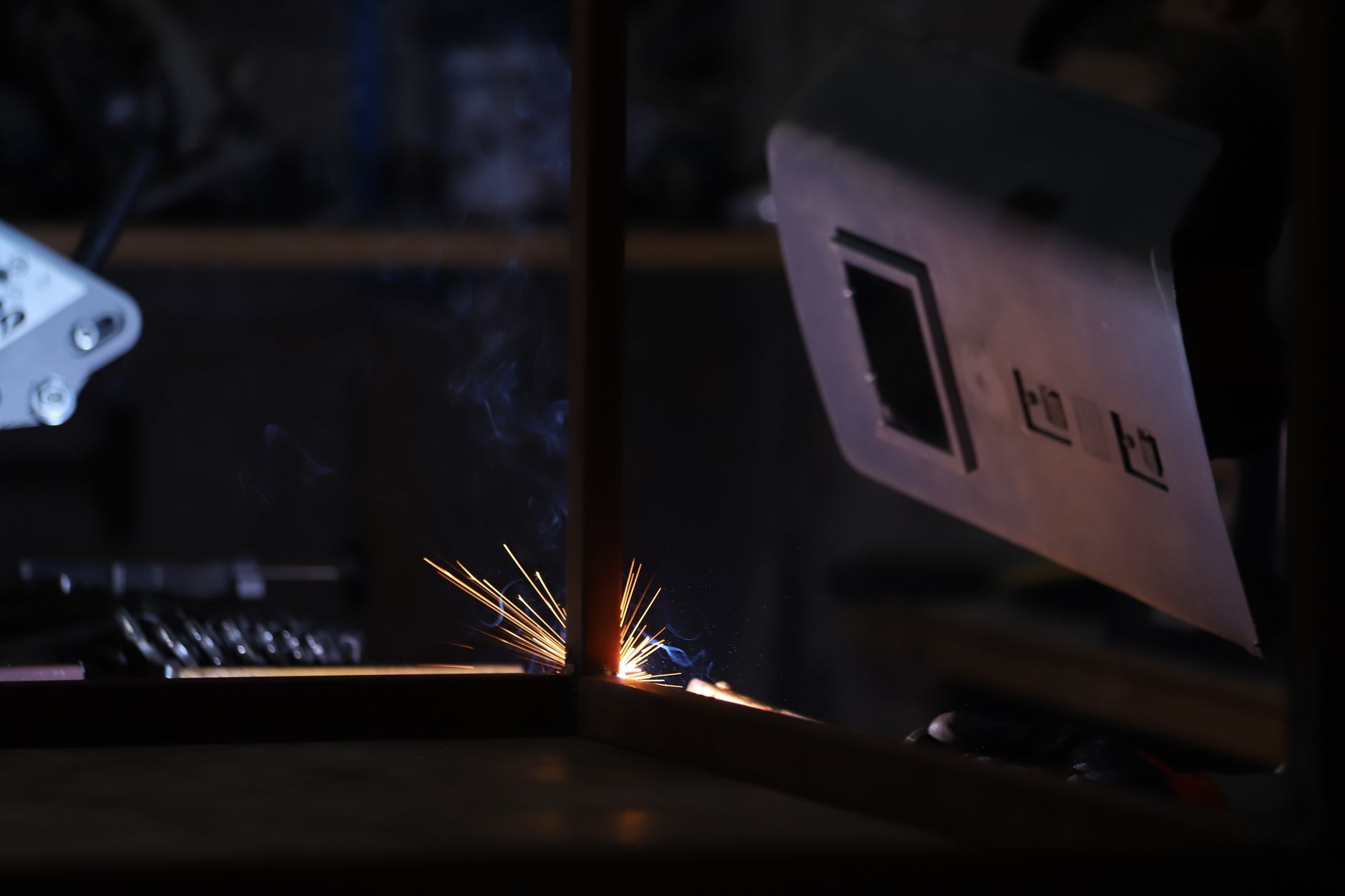
Catalogue fire sleeves come by the metre, with a set inside diameter and a closure meant for a fixed hose. On a robot, the same sleeve meets different conditions. The bundle changes length as the wrist rotates. A sleeve fitted snug at one end ends up bunched or stretched at the other. Hook-and-loop closures collect spatter and stop gripping. Sewn ends fray where the bundle flexes.
The sleeve then creeps along the bundle during a shift and leaves the torch neck bare. That is the part that needed it most. Crews respond by taping the ends. Tape holds for a while, then adds a stiff point where the cable bends, and the cable fails earlier. This is when a buyer of catalogue sleeves starts asking whether a fitted sleeve would cost less over a year.
Fire sleeve or custom dress pack protection: how they compare
| What you compare | Catalogue fire sleeve | Custom dress pack protection |
|---|---|---|
| Fit | Standard diameters, cut to length on site | Patterned to the route of the bundle and the robot model |
| Movement | Designed for a fixed or slow-moving hose | Allows for wrist rotation and the change in bundle length |
| Torch end | Same fabric along the run | Reinforced zone where spatter lands |
| Closure | Hook-and-loop or open wrap | Closure placed away from the spatter side |
| Replacement | Cut off and refitted by hand | Planned part, fitted without removing the bundle |
| Best for | Short static runs, spares, one-off repairs | Welding robots running long shifts |
Neither column is wrong. A catalogue sleeve is right for a hose that stays put, a test bench or a temporary repair. Custom work earns its cost on the robot that welds every shift. There the bundle moves with every cycle, and downtime has a price. For the wider choice between sleeves, bellows and jackets, see our complete guide to robot sleeves, bellows and jackets.
What the safety rules already say about flameproof covers
Welding safety rules treat the area around a weld as a fire zone, not just a hot spot. In the United States, OSHA’s rule on welding, cutting and brazing asks employers to move combustibles at least 35 feet (10.7 m) from the work site. Where that is not possible, it asks them to protect combustibles with flameproofed covers or shield them. The text is in 29 CFR 1910.252. The rule covers the work area, not a robot, but the logic carries over. A cable jacket within reach of spatter is a combustible. A flameproof covering is the accepted way to protect it. Check the rules that apply in your own country and plant, because requirements differ.
How to read a fire sleeve product sheet
Catalogue fire sleeve listings look alike, so the product sheet decides. Start with the material and the build: a braided or woven fabric, or a coated one, behaves differently under spatter and flexing. Look for the inside diameter (ID) range and compare it with the real size of your bundle, with its connectors. A temperature rating means little without the exposure type behind it. Ask whether the manufacturer rates the product for continuous heat, for short spatter contact or for both, and how it was tested. Flame resistance and abrasion resistance are separate properties, so check both. Then look at the product range: does the same maker supply end caps, straps and replacement lengths? Automotive welding lines in particular burn through sleeves quickly, so a supplier that ships replacement parts fast matters more than a small saving on the first set.
These checks apply to any catalogue part, ours or someone else’s. They also show when a standard product reaches its limit. A sheet cannot tell you how the sleeve behaves on a wrist that turns thousands of times a day.
Questions to ask before you buy a catalogue fire sleeve
Not every buyer needs custom work. Five questions sort the cases quickly.
- Does the bundle move during the cycle, or does it stay fixed?
- Do the hoses and cables inside have to slide freely at one end while the sleeve holds position at the other?
- Can the closure sit on the side away from the spatter?
- How fast can a technician change the sleeve, and does the bundle have to come off?
- Is the torch end of the sleeve the same fabric as the rest, or reinforced?
If the answers are all comfortable, a catalogue sleeve will do the job. If two or more answers point the wrong way, the cell is a candidate for a fitted sleeve. We tell customers when a catalogue part is enough, because a sleeve that fits well from the shelf is cheaper than one we make.
Routing and fitting habits that make a sleeve last
A few habits stretch the life of any sleeve, catalogue or custom. Keep enough slack at the wrist so the bundle does not pull against its ends. Check that the torch angle does not point the spatter straight at the sleeve seam. Clear built-up spatter from the sleeve surface at each tool change, instead of letting it harden. Fit the new sleeve over a clean, dry bundle, and make sure the ends sit under a retaining strap that does not bite into the jacket.
Write down the date of each replacement and what you saw. After a few cycles of replacement, the log tells you the real interval for your cell, which is more reliable than any general figure.
Reading the wear: when to replace a fire sleeve
A fire sleeve that has done its job looks worn outside and intact underneath. The signs below say it is time to swap the sleeve, before the cable jacket takes damage.
- Spatter that has fused into the fabric surface and no longer brushes off
- Charred or hardened patches at the torch end, or at the wrist fold
- A sleeve that has crept along the bundle and left the torch neck bare
- Frayed or open ends, and closures that no longer grip
- Stiffness in the bundle at the wrist that was not there before
- Any damage to the cable jacket under the sleeve, even a small one
The interval depends on the cell, not on a calendar. A cell with long arc-on times and a spatter-heavy process wears a sleeve far faster than a light assembly weld. The best habit is to inspect the torch end at every tool change and log what you see. Our guide on when to replace robot protection components covers the intervals and the inspection points in more detail.
What this looks like in a welding cell
Picture a supplier of welded chassis parts whose robot needs the outer jacket of its dress pack replaced again and again. The catalogue sleeve over it slides toward the wrist within days and leaves the torch neck bare. A sleeve patterned to the route of the bundle changes that. It has a reinforced torch end and a closure on the side away from the weld. The jacket then lasts much longer, and the robot stops losing time to cable swaps.
Or take a metal fabrication workshop with several welding robots. Crews wrap the torch cables in tape and cut new sleeves each time spatter comes through, and every repair eats into the shift. A sleeve with a split closure lets a technician change it in place without removing the bundle. These are generic scenarios, not results from a named customer, and the gain depends on each cell.
What to send us before a welding robot sleeve is built
A short file is enough to start. Send the robot make and model, plus the number of hoses and cables in the bundle. Add a photo or two of the dress pack, taken at the torch end and at the wrist. Give us the welding process, the typical arc-on time and the shifts per day. Tell us where the current protection fails first, and whether the sleeve creeps. If you have a worn sleeve, send it. The way it has burned tells us more than a specification sheet.
Our welding sector page sets out the protections we make for these cells. The bellows and sheaths range shows the sleeve-type parts we build to size. If the sleeve comes off often for maintenance, our guide to removable robot protective covers helps. For the arm itself, read welding robot protective covers.
Burning through sleeves on a welding robot?
Send us a photo of the worn dress pack and the robot model. Our design office replies with a sleeve built for your cell.
Send your dress pack photos →FAQ
The basics
A fire sleeve is a fabric tube with a flame-resistant face that slides over a hose or cable. It protects the bundle from weld spatter and radiant heat. Some suppliers call it a heat resistant sleeve or a heat shield sleeve.
The names overlap. Both protect a hose or cable from heat and molten spatter. What matters is the construction of the product: the fabric, the closure and how it behaves when the bundle moves. Ask for the build, not just the name.
No. It slows down damage from spatter and radiant heat, but every sleeve wears out. That is why inspection and replacement at the torch end matter.
Welding robots and dress packs
At the torch end, where spatter lands directly, then at the wrist fold, where heat and flexing combine. The underside of the arm comes next, because falling spatter settles on the sleeve.
The bundle changes length as the wrist rotates. A sleeve fitted snug at one end ends up bunched or stretched at the other. A sleeve patterned to the route of the bundle, with secure ends, holds its position.
Yes, for a short static run, a spare or a temporary repair. On a robot that welds every shift, the bundle moves with each cycle. A fitted sleeve usually costs less over time because you change it less often.
Specifying and replacing
There is no fixed interval. It depends on arc-on time, the welding process and how close the sleeve sits to the arc. Inspect the torch end at every tool change. Replace the sleeve once spatter has fused into the fabric or the jacket underneath shows damage.
The robot make and model, and photos of the dress pack at the torch end and the wrist. Add the welding process, the shifts per day and where the current protection fails. A worn sleeve is the most useful sample.
Yes, if it has a split closure on the side away from the spatter. A technician can then fit a new one in place, which shortens the stop.
In Summary
A fire sleeve earns its place on a welding robot when it holds its position, covers the torch end and can be changed quickly. Catalogue sleeves suit short static runs. Where the bundle moves with the wrist and the cell runs long shifts, a sleeve built to the route of the bundle lasts longer. It also costs less to live with.
For material, closure and fit across hoses and cables, read our guide to the protective sleeve. Our technical glossary defines the terms used above, and the protections by sector page lists the full range.
Ready to protect your welding robots?
Send us the robot model and a few photographs of the dress pack. Our design office prepares a made-to-measure sleeve, with a free assessment.
Request a free assessment →See also our range of custom robot covers.